Wednesday, July 06, 2022

The sad conclusion to a hit piece.

So, I finished listening to @christianitytoday 's "Rise and fall of Mars Hill" a few days ago, and I have to say, they are definitely living up to their name.

They are focused on Christianity as it exists today, rather than the timeless, inerrant Word of God.  In fact, one sound bite they chose to include was something to the effect of:  "When you believe the word is inerrant, Mars Hill is the inevitable result", then gave no pushback.

Christianity Today used Mark Driscoll and Mars Hill as a hit-piece to bash evangelicals, complementarianism, and conservatives while promoting deconstructionism, progressives, and feminism.  Their use of music was not subtle.  Whenever talking about Driscoll and the things he believes in, it's all minor keys.  

I laughed when they brought in the author of "Jesus Feminist" to give her opinion.  Like she was going to say anything like, "You know, I can see both sides."

Cultish had an interesting teardown of the podcast here (special thanks to @andrew for bringing it to my attention):  

https://www.youtube.com/watch?v=7M3p8mRmJIc

and here:

https://thecultishshow.com/podcast/mark-driscoll-cult-of-personality

In it, there a few things of note:

1)  The only scripture in the entire series up to that point was when they pulled a Driscoll soundbite.  None of the points of accusation referenced anything of a scriptural shortcoming.  Their entire condemnation of Driscoll was done with current cultural mores that they feel he violated.

2)  Christianity Today has a real problem with war metaphors as Driscoll used them.  This is despite the extensive use of war metaphors in the New Testament.  

Now, I do agree with some aspects of their depiction of Driscoll; however, as they stated in their podcast, why should we focus on any of the good stuff when there are people bleeding?  In a similar vein, why should I focus on any of the things I agree with them on when they are wrong on others?

This is just conjecture on my part, but I suspect that the concept of a Jesus that is either a baby, a willowy hippy, or hanging on the cross is their preferred image of The Christ.  Their version of Christ is someone they could beat, so they don't have respect for Him.  They can give lip service to the New Testament, but can talk around it because they don't really feel the need to be put under His authority.  The concept of Jesus as a strong man frightens them, because they might have to pay attention to EVERYTHING he said.

Without this fear, they selectively pull from verses about being at peace and love, while ignoring the verses about removing those that claim Christianity but walk a different lifestyle.  They can also not envision the terrifying image of Jesus violently removing the people that had desecrated His Father's house.  

Jesus famously said that if anyone caused one of His little ones to stumble, it would be better for them to have a millstone tied around their neck and plunged into the ocean.  

Christianity Today does this throughout the podcast by treating deconstruction as just another kind of walk a Christian can take.  I think the most telling is in the closing episode, where they refer to some of Driscoll's former parishioners as "Embrac[ing] a life without faith", rather than the tragedy of people having lost their faith.  I think Jesus' words were specifically intended for the makers of this podcast.

Saturday, July 28, 2018

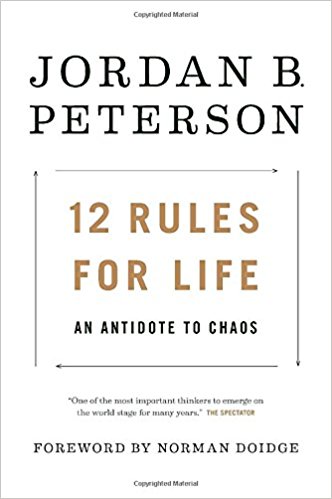
Review of "An Antidote for Chaos"

Image result for antidote for chaos chapter titles
https://www.amazon.com/12-Rules-Life-Antidote-Chaos/dp/0345816021/ref=sr_1_1?ie=UTF8&qid=1532802559&sr=8-1&keywords=antidote+for+chaos&dpID=412z30W2N-L&preST=_SY344_BO1,204,203,200_QL70_&dpSrc=srch

So in the past few weeks, driving between work and home, I've been listening to Dr. Jordan Peterson's "Antidote for Chaos: 12 rules for life."

Despite the self-help-y title of the name, it actually is a fairly interesting read, especially from a Christian perspective.

It is better read as the attempt by a doctor to quantify and summate his observations over many years of clinical practice rather than something he postulates for the purposes of publishing.

As detailed in the foreward, each rule was initially posted online until a publisher asked him to take each "rule" and expand upon it. He discovered that he had a lot more to say on each one, and developed an essay for them, going into the history of that observance, relative academic work, his own clinical experiences, etc.

There is a fair amount of religious imagery in the book, most (but not all) coming from the Bible. In those instances, he pulls a number of things together that I thought were interesting:
  • He weaves a narrative that, even if the Bible isn't true, it has been the core document responsible for western civilization, which, in turn, has, in a relatively short amount of time, advanced mankind from mostly abject poverty, to levels of freedom that are unprecedented, and luxury that even kings a hundred years ago couldn't conceive of. As the core document, the instruction contained within the Bible must be of vital importance for societal cohesion, and the truth for living has to be examined to determine why.
  • Living a life without the idea of God justifies horrors inflicted on one another in a grand scale. He uses the Columbine shooting as a case study several times. Evidently, one of the shooters tried to write out why he felt the way he did before committing the heinous act. Pastors have been using those writings for years to warn against spiritual collapse. However, when the book views it through a psychological eye, then pairs up with a psychological view of the Bible, the results are sometimes bone-chilling. 
  • The psychology of the people of the Bible. We think of them mostly as 2D characters, there for a simple spiritual lesson in light of Jesus, then disposed of. The exploration as to the psychology of their experiences in terms of the Bible, the correction/path change in the Bible, then the circumstances under which we conduct ourselves today was illuminating. Of interest was the close examination of Cain and Abel. One of the things that was particularly illuminating was the need for self-reflection upon failure due to insufficiency. Cain's inability to do so led him to blame outside factors, and take "revenge" upon God by killing Abel. The psychology behind such actions is still with us today, and the book brings it out in vivid detail.
  • The need for Biblical sacrifice, wisdom and living, even in absence of the Bible as a divine document. This was a hard thing for me to deal with. It almost seems like Dr. Peterson (who, by his own account, hasn't made up his mind on the existence of God, but "acts like God exists"), is offering a substitute of Biblical wisdom for those that reject the Bible as the inerrant Word of God. One part of me thinks that this allows people to reap the benefits of living a principled, Godly life without being saved. However, the other wonders if this might be a gateway to get people in a Biblical frame of mind. I haven't resolved this yet.
  • Each chapter has a somewhat curious title that he explains, but he goes into Jack-Hayford level of background to get around to explaining the meaning (those from CoTW know what that means). The stories are at times interesting, tragic, playful, funny, and insightful. Usually a mix. 
Many have tried to pin certain political or spiritual motives to Dr. Peterson in light of this book, usually without reading it.

However, after listening to it, particularly with his emphases being read by the author himself, you realize that his only drive is to get to the truth of a situation.  He's extremely clinical about almost everything he approaches.

I would recommend this book, not as a "it is truth, and you must adhere to what it says", but from a "it will at times reinforce or challenge what you think" standpoint.

Saturday, April 07, 2018

The most inconsiderate Husband ever...

The most thoughtless birthing partner father ever.

(Please note:  I plan on being ultra supportive when Tabitha has our baby.  Inspiration just struck me here, so I thought it'd be funny to go with it.)

At around 3AM, Tab said she had her first real contraction.  She had been having Braxton-Hicks contractions for weeks now, but I had dutifully reminded her each time that it wasn't REAL labor unless they were closer together.

When she told me that they were around 10 minutes apart, I reminded her of what we learned in our birthing class, and that we needed to go in when they were 4 minutes apart.  Guesstimating in my head, I told her to wake me up when they were six minutes apart.

She became so antsy every time a contraction hit that I finally got up in a huff and slept out on the couch, despite it likely ruining the pace of my entire day.

I was awoken 3 hours later by Tabitha nudging me awake that they had finally reached six minutes apart.  I got up and trudged to the bathroom, indignant that she had broken up my sleep.  I took a long, hot shower and finally packed my bag for the hospital trip.

I got in the car, then proceeded to wait 10 minutes for her to gather her prepacked bag and get in.  Once she did get in, I asked if she had locked the door.  As she couldn't remember, I told her to hurry up and check, as she was keeping us from getting to the hospital.

While waiting in the lobby for Tab to park the car, I caught up with the news of the day, checked in to the hospital (I'm the mayor now on Swarm!), and made sure everyone on social media knew we were about to give birth.  As soon as Tabitha got back from the parking structure, she wanted to check in, but I had her wait while I set up the perfect selfie to commemorate the occasion. 

Checking in was fairly uneventful.  We went into the birthing triage room, and spent the next hour there.  The nurses were very attentive towards Tabitha, but refused to go into any depth as to the coffee offerings of the cafeteria below. 

After being demoralized about having to likely put up with substandard coffee, we finally got admitted to the delivery room around hour 7.  I decided that I needed a break, so I got into the relaxation tub.  Boy were they right!  This thing had jets, and even soothing lights to help calm you.  The only thing that ruined it was the screaming woman outside the bathroom.  I yelled for them to quiet it down.  After all, this was ME time.

The doctor came around and told us that if we wanted an epidural, this was the time to do it.  Tabitha said the pain was severe, and that she really thought she needed it. 

Fortunately, I was on hand to remind her, as well as tell the doctor, that we didn't want it, as we were trying to keep costs down on this birth.  "Remember what we said a month ago dear:  No sense going into debt because of this child."

After 13 hours, I told Tab to wrap it up, as the novelty was wearing off, and that, frankly, she was starting to look like an attention hog.

I'm guessing it worked because, after only an hour more, she finally began pushing.  They asked me to cut the cord, but I said no.  It looked unsanitary.

They asked Tabitha if she wanted the baby immediately.  She said yes, but, again, in order to keep things sanitary, I insisted they wash the baby off first.  It look goopy.

Before checking out of the hospital, they insisted that we have a baby seat in the car.  I unsuccessfully tried to argue that my parents didn't have a baby seat when I was brought home, I begrudgingly installed it.  Driving home, Tabitha insisted on sitting in the backseat, despite that this was the first time I actually wanted to talk with her, as she wasn't complaining about pain anymore.

Arriving home, I turned on the TV and returned to my Netflix queue.  I was drastically behind, and needed to really power through to get back on track.

Fatherhood is going to be great!

Thursday, November 30, 2017

So, this is a season of transition. A year and a half ago, I moved sites in my company, Tabitha is pregnant, she moved to a new job outside the company, we moved into a house, and my parents have moved next door.

To add to this all, it has become painfully obvious that my Mustang was not going to cut it in this new phase of my life. So, after 16 years, I decided to finally trade it in for something with a viable back seat. (I can just see the dirty jokes forming in your head)

Unloading all the stuff out of the car, I was hit with a flood of memories:

It was 2001. I was in the final quarters of my Undergrad, and decided to treat myself after a grueling six and a half years in College. I had destroyed my Saturn in a car accident a few months previous.

(Fun fact about the Saturn: My previous car, a Red Ford Probe, had a spacious backseat. The Saturn SC2 did...not... As I was the perpetual DD in college, every time Sev would emerge from the backseat, he'd say, "It's a boy!")

Wanting something with a little more pep, I bought a 1999 "Cinnamon" V6 Mustang with 30,000 miles on it.

One of my very close friends ridiculed me for getting it because, "that's the kind of car you get a girl on her sweet 16." My other friends teased me about getting a FORD ("Fix Or Repair Daily", "Found On Road Dead").

Over the course of the next year, I drove back and forth to Cal Poly Pomona from Woodland Hills 2-3 times a week to finish up my few remaining classes.

I graduated, and hung my tassle there until 2006-ish, when a drunken careless date yanked it down because, "you needed to get rid of that anyway." Upset, and, kinda angry, I threw it in the back, where it was tossed around until I found it last night.

In December of 2002, I got my Job at the Naval Surface Warfare Center Port Hueneme Division. For 3 and a half years, I drove from Woodland Hills to Port Hueneme (one hour each way), putting 100 miles on it every day.

On top of that, most of my friends were at Glendora Alliance Church, so I'd drive an additional hundred miles every weekend to see Matt, Angi, Cameron, Brian, and crew.

I remember a bleary Saturday, waking up in Shannon's house after my going-away party from NAVSEA with the worst hangover I've ever had. (Erik, Sev, and Derek know the one) The Mustang was a manual Transmission, so it was quite a feeling to be pissed at the clutch for being too loud. I packed that car up with all my day-to-day possessions (It wasn't much), then drove out to Goleta to work at my present job.

The next couple years were a blur. I would visit mom and dad in Woodland Hills, my brother John in Costa Mesa, I drove to Vegas twice to support Dennis at the Scottish Festivals, etc.

It was the car in which I made my initial trip up to Stanford to visit my good friend Eric, and started the annual trip to The Great Dickens Christmas Fairthat continues to this day (Next weekend, in fact!)

Then, in a hospital room in 2008, I met a girl. We dated, and she moved up here. For a long time, my Mustang was "the good car" that we'd take when we were trying to look spiffed up.

(Side note: I had promised Tabitha that I would teach her how to drive a manual when I was going to turn the Mustang in. I forgot to do that, and now both our cars are automatics. Oops.)

Despite the years, after 249,000 miles, the Driver's seat was somewhat thrashed, the center console no longer "clicked" close, and the steering wheel was starting to disintegrate. The evaluation at the dealership listed the color as "Was Red"


It was a good little car that gave me very few problems, and I'm sad to see it go. But life is continually about new beginnings, and I'm excited to see where this one takes me.

In a related note, if anyone wants a 1999 Mustang, with a quarter million miles on it, and a severely oxidized paintjob, please contact Toyota of Santa Barbara.


Thursday, December 15, 2016

Unsilencing of a point of view...

Recently, I've been observing that a number of people on the other side of the ideological aisle have run amok online describing how "unsafe" and "scared" they feel.  They think that the country has taken a step back, and things are no longer as good as they once were.

First, I'm old.  I've seen more than a few elections.  I understand the feeling on election night of being on edge during the count, culminating in either a sigh of relief when your candidate wins, or the uncertainty of having a president elect that doesn't champion your values.

However, I remember when I was in college in 2000, and people didn't feel this way.  They grumbled that W won the election, but nobody ran around feeling like their country was in danger in any way.  I was on a fairly liberal campus, and, besides the usual "effing Republicans", there wasn't a huge outcry, especially considering the election was literally decided by fewer votes than the people in my dorm.

So, while it would be easy to say, "Well, Trump/Pence are just THAT evil", if one steps back and looks at the changes to the country at large, we might be able to piece together some other major contributing factors.

First and foremost, there is a push to make people as thin skinned as possible.  The rise of the theory of "intersectionality", third wave feminism, "triggering", "safe spaces", offense at not using arbitrary pronouns, etc. has resulted in people that are incredibly unable to take a critical view of their own beliefs, lest their self-induced identities be jostled.

That entire line of thought ensures that people with opposing viewpoints co-exist without having to challenge one another.  So, the idea that anything would not go their way, or that people might inherently disagree with their point of view, is incredibly difficult to handle.  After all, in their relativistic world, they are right 100% of the time.

And it doesn't end with their viewpoint.  They attempt to enforce it on everyone else I.E. if you don't agree with them, you are painted as racist/sexist/homophobic/hate speech/etc.  You can have your own identity within their walled garden, but don't you dare attempt to climb out of your intellectual gilded cage.

Now here's the thing:  for 30 years, This kind of talk has effectively killed any form of discussion.  The conservative viewpoint has started with an inherent disadvantage.  Before a debate can even begin, they have to justify how they are not deserving of the label of racist/sexist/etc.  This means that the conservatives have been on defense in the public discussion arena for a very long time.

The fact that this tactic has been so effective at silencing conservatives demonstrates the level to which people are not racist:  the idea of even being thought of as racist is enough to dissuade people from engaging in political discourse.  As such, it has been professionally and personally dangerous to hold anything but the liberal point of view for some time now, due to the wide paintbrush of racism/sexism/etc. for anyone that dares step off of the ideological reservation.

What we are seeing in this latest election is the rise of a different breed of conservatism.  These aren't people that are willing to let accusations dissuade them from engaging in political discussions.  They know they aren't racist, sexist, etc.  So, when the left trots out its usual paintbrush, the response is, "No, that's not me.  Please try again."  They aren't racist, and aren't going to roll over and play dead from the usual bag of tricks.

Even attempts to double down using hyper sensitive labels and concepts like "toxic masculinity", "institutional racism", "white privilege", etc. are met with incredulity, scorn, derision, and the loss of an election.

Additionally, conservatives have typically been reserved when it comes to making their political points, relying on typically dull presentations, following laws/rules/analyzing the math/etc.  The other side has not felt the need to maintain themselves along those lines, and enjoyed the ability to be disruptive/rude/shocking/etc. and make their points typically via emotional appeal, which is seductive, in that it provides good feelings over facts.

What is surprising is that fact-based political commentary is providing the best counter this time around.  Granted, it is in a new package that makes it much more easier to present and digest.

People like Ben Shapiro are leading the charge, providing targeted, concise facts to support the conservative point of view, without being mild or gentile about it.  His key phrase is, "facts don't care about your feelings", a phrase which strikes at the very heart of the left's appeal.

As a counter for the more outrageous, they are met by Steven Crowder, who delights in being a provocateur.  He punctuates his talking points using edgy language calculated to troll the other side of the ideological aisle, as has been done in reverse for 30 years.

So they are being met on the high road intellectually, and the low road with the name-calling.  They don't enjoy the smug superiority they once had anymore.

I can understand why the left is now scared:  now they have to defend their viewpoints, and can't shut down their opponents with emotional manipulation.  Their opinions can now be scrutinized for content as opposed to relying on people's sympathies.  Additionally, they are no longer the sole owners of edgy political discourse;  It is now possible to be edgy as well as conservative.

And on that, I can sympathize with the left:  it is an enormous feeling of loss and worry to have been dominating a field for a long time, only to have a serious challenger appear.  I felt the same way when x86 systems had effectively killed Macs, only for the first generation iMacs to appear all over campus.

I look forward to the next few years.  The spell has been broken, and conservatives are now free to come out of hiding and express their viewpoints without reprisal.  There is an open marketplace of ideas that is now ripe with true variety.  Only the close minded would mourn such a rich diversity of thought.

Saturday, November 19, 2016

If I ran things (as if anyone would ask me to)...

So, I wrote this in 2012 to get it all down.  I've recently revisited it, and made a few modifications here and there to account for recent changes in philosophy, but it is interesting how most of it still holds for today.

In writing my thoughts on all things political, I've realized that I need to be very careful in what I say, not only for my career, but because I don't like to alienate anybody.

I enjoy intelligent discourse, as it has shaped my personal point of view. So, when writing this, I subscribe myself to a phrase I have learned to love:  "Be mellow or be gone."

These are MY points of view. I present them as how I think of life here in these United States. If you have a differing opinion, I welcome it in a friendly interaction. 

In the past, I've been more hot-tempered.  My earlier discussions sprinkled over the internet are someone I'm eager to distance myself from (seriously, if you bring them up, I'll send you a polite, "yep, that was me" email back). I've had a chance to evaluate life, and I am glad to entertain people in a more give-and-take format, as long as they are not violating my new favorite phrase.

To me, the construct of a political party is like cable television packages -- You may want to just get HBO and Scifi (it will NEVER be SyFy in my mind), but you are going to get all the oddball channels you will never watch anyway.

I find myself leaning towards what some would consider a Republican slant, but I find that so many who also identify themselves as Republicans cause me extreme facepalms. I got interested when the Tea Party started up, as I thought it would be a return to Conservative ideals, but then the media chose to focus on the racist nutballs that showed up to their demonstrations.  This had the effect of blunting the movement by being characterized as racist, uninformed rednecks, forcing them to silence themselves.

While I liked their ideals, I think the attempt to create a third group out of nothing was a mis-step, as well as their almost non-response to the racist goobers that kept showing up to their events. To that end, I've thought about the creation of a movement inside the Conservative ranks that would distance themselves from the social nature of Conservatism that usually mire the rest of otherwise like-minded people.

Because when you boil all the different social pushes away, you get to the core of what Conservatism is: giving people the opportunity to succeed as individuals in the United States.

Please don't misunderstand me: I am a Christian, and I'll proudly say that, but I don't think that Christians are doing the right thing by pushing to legislate socially moral code.  You can only legislate morality insomuch as action, never intent.

In any case, for those of you Christians out there who are going to read this and wonder how I can reconcile my Christianity with what I am about to propose, I've created a section at the end of this post that will explain everything, in my mind, anyway. For those of you not of a Christian persuasion, that section will have a lot of Christian terms that might require a bit of translation. Chances are, if you get offended, you are misunderstanding what is being said.  I'll be happy to clarify if it is needed.

I've struggled with what to call this idea, and the best I can come up with is, "Conservatives Without A Social Agenda". I think that the proper place for government is out of the social agenda of either side.  There are ideas here that are going to make Conservatives hoop and holler with glee, but then turn around and piss them right off. Stick with it to the end, and you'll see my justification for everything.

See, I've long looked at people who call themselves Conservatives, and thought, "wow, what a bunch of pious gas-bags." They radically mis-interpret The Bible to their political ends, or legislate morality that they clearly don't follow or understand. They know that they can pander to their constituents with a token morality play without making meaningful changes to their own lives.  I think this movement will remove one of their tools of manipulation of the Christian voter.

Likewise, a candidate that might have sound ideas can be mired in talk of "is he conservative enough" if his perceived social agenda doesn't line up with hardline conservative social thoughts.

It's a distraction that doesn't help anyone in the long run, and only serves to further divide otherwise sound schools of thought.

My first thought that I wish to address actually comes from the Liberal point of view: "You can't legislate morality." I agree with this 100%. I don't think you can make people be nice to each other, join a religion, be upstanding people, etc. through laws.

However, there is a flip side; a corollary, if you will: "you can't legislate concern for your fellow man."

So much of what people concern themselves with in the public forum is an attempt to shape the social atmosphere of the country. My point of view is that the government should not concern itself with the social whims of the populace, but should instead provide a framework that people can use. 

Government needs to stop trying to edge closer to providing their citizens with "safe spaces", and return to being a jungle-gym that people can launch their lives from. To pull the analogy out further, it's time to take the rubber safety bumpers off.

I suppose before I go further, I should explain my background: I am an engineer. The rampant viewpoint where I work is one of, "I don't care what your background is, who you are, or where you come from. Can you get the job done within X days and with Y budget? Yes? Get it done then." 

Engineers are free to dream up new ideas, solve problems, and, (with a minimum of politics) rise through the ranks as their solutions are deemed good or not by bosses and outside customers. The best description I can come up for this environment is a "meritocracy." People are advanced or held back based on their usefulness.

This is how I think government should interact with people. We need to remember that The Constitution only guarantees us the "pursuit of happiness", not happiness itself.

So, this posting is my attempt to go through issues, if I was Conservative, but had no social agenda.

We'll start with something nice and easy, like Gay Marriage: As far as the government is concerned, people of the same sex shouldn't be considered "Married."

If you stopped reading at this point and decided to post a nasty response, or closed my blog, it means you are not open to discussion. (Of course, if you did that, you're not reading this either. So let me say some nonsense in here: bliggidity nando bloopski!)

Let me continue: people of the opposite sex shouldn't be considered "Married" either.

Frankly, the government shouldn't be capable of defining what is or is not a marriage. That should be a matter for the religious entities to determine for themselves. As far as government is concerned, people (gay and straight), both should be in the state of "civil union" with their "partner."  The word "Marriage" ascribes too much religious and societal connotations. As long as insurance, benefit coverage, etc. are equal amongst the various forms of civil unions, there shouldn't be a problem.

This is not "separate but equal."  This is just "equal."

I know it feels like a parent saying, "if you aren't going to play nice, then neither of you gets it", but we as a society need to move on. These two groups are never going to effectively communicate, never relent, and only shout louder.

Next up on my list in terms of easy-to-tackle points: gun control. On this topic, I agree pretty much with the conservative view, but think it has been drastically misrepresented, with conservatives hesitant to speak up.

So let me get up on this little soapbox and squeak: The purpose of the second amendment is not to protect one's house, nor to hunt; it was to prevent a coup from those in power to declare democracy a failure, and revert to a non representative form of government.

Ironically, one of the most common name-calling jibes the Liberal side tends to heap on the Conservative side is "fascist."

 Allow me a diversion for a moment. I promise to return to the previous point:
"but if circumstances should at any time oblige the government to form an army of any magnitude that army can never be formidable to the liberties of the people while there is a large body of citizens, little, if at all, inferior to them in discipline and the use of arms, who stand ready to defend their own rights and those of their fellow-citizens. This appears to me the only substitute that can be devised for a standing army, and the best possible security against it, if it should exist." --Federalist Paper #29.
For the "tl;dr" crowd, that means that, if anything, the Second Amendment proliferation of firearms should be on the same level as our armed forces such that if a fascist government did pop up, the people could overthrow them with comparable armaments.

So the people calling conservatives "fascist" should be advocating the proliferation of firearms, such that if fascism should come to power, it can be overcome.

The biggest issue that I can see is that, while I can agree that the handling of such requires a level of respect, the idea of severely disarming our country, or only leaving them with token firearms runs contrary to what the Second Amendment was built for.

Another point is that the only people that follow firearm laws are law-abiding people. Criminals, by definition, do not follow the law.

92% of the more horrific gun-sprees in the last decade have taken place in places that have taken pride on being "gun-free zones."  All gun-free zones means is that you have concentrated a population of targets. As my friend Jason says: "when seconds count, the cops are minutes away."

The failure of gun laws isn't in the laws themselves, but rather the implementation. The DROS delay should be a quick online check that takes seconds.

From there, you should be able to purchase as many firearms as possible as often as you like. If you get convicted of a felony, it should trigger that you have guns, and they need to be confiscated. If you try to purchase another gun, a quick online check should deny the sale.

The California restriction of one gun a month, and a 10 day delay each time is silly. It is a question of a viable IT infrastructure, not draconian laws.

Next on our topic of light friendly discussion, we have abortion. I think they should be legal, and I think the government has no business funding it in any way.

The argument for abortion is that it isn't a person, it is classified as just a bunch of tissue, so it shouldn't be given special funding or status. If that is the case, government should not be involved in funding what is an inconvenience procedure 90%+ of the time.

And laws that declare the death of a mother and her child/fetus should return to being a single murder charge. Either it is a person or it is not. Our laws should be uniform.

College and Arts funding -- The US has fallen drastically behind in Science, engineering, math, etc. graduates. I think there is one way to fix that problem: stop giving student loans or grants to anything but Science, Technology, Engineering, and Mathematics.

Go onto any campus, and you'll see people floundering in college, often settling on a humanities/liberal arts degree as a means to "get a college degree". Meanwhile, they rack up huge student loans.

I think being a liberal arts or humanities degree should be a burning desire. It should come from the same well of desire that pushed many of our cultural greats to develop their talent further.

It should not come from, "I flunked out of differential Equations, so I had to change majors, and English seemed like a good fit because I can read."  As an engineering major, I saw this story play out many, many, many times.

This also explains why I feel the way I do about government funded art: it shouldn't exist.

Art should bring about funding due to the patron desiring to fund it, or a burning need to create, not out of a section of taxpayer supplied budget.

Now for General Education. Having been a product of the Los Angeles Unified School District, I can tell you what needs to happen: The responsibility of the school should be to its students and local residents, not to a remote Superintendent a hundred miles away who has little day to day involvement with the students and staff.

Next is unions: a minor thought, but I think that unions are a concept whose time is done. In the day and age of class-action lawsuits, the original purpose of the union is gone.

Now they serve little purpose, very often destroying the workers' companies, and arguably, entire industries, while claiming to help the workers.  (Ever wonder why US-made Steel was virtually non-existent until just a few years ago?)

Embryonic Stem Cell research. This is one where I think both sides need to chill the eff down.

Researchers have gotten down to base cells from skin cells, perhaps negating the need to use embryonic cells. If not, the use of the remains of IVF treatments after a successful fertilization would make for good resources. They are going to be thrown away anyway. Might as well put them to good use.

Overall, the government needs to get out of the business of competing and instead remember that its only job is to regulate. Like the jungle gym analogy earlier, it needs to provide just the base frame for others to launch from.
  • It should ensure no monopolies, oligarchies, or collusion exist in a given industry. 
  • It should ensure valid competition exists, all proper regulations are being followed, then move on. 
  • It should never be viewed as a profitable enterprise. 
  • No company should ever be considered "too big to fail." 
  • Corporate personhood should include the right to have said person arrested. 
  • Banks and financial institutions should be more highly regulated.  However, that regulation should be just that, regulation. At no point should it enter into the fray and provide a government alternative. 
The next one is a touchy one (like what else isn't on this list?). I'm talking about environmentalism. I think people can agree that the earth is changing. And I'm sure that is a scary thing.

The ground is supposed to be "solid". There seems to be this need to change things "back" to the way they were, forgetting that nature itself is a moving, dynamic, changing thing. We've only been seriously taking samples for the last ~200 years, which is a small thing. We are extrapolating data from indirect means past that.

We have lots of scientists chasing lots of dollars to come up with ways that humans are causing it, as that is where the grant money is.

I'm not saying industries shouldn't try to get off of oil. I'm saying that people who claim that, "we need to come up with ways to reduce emissions! Why is that so bad?" 3 things on that subject:

  1. If humans aren't the cause, or are, at most, a minor contributor to an otherwise natural phenomenon, we are spending many hundreds of billions of dollars on nothing. 
  2. We are imposing restrictions on third world countries trying to get their manufacturing infrastructure up and running. They are trying to lift themselves out of poverty, but we in the first world are imposing our worries and concerns on them. 
  3. The need to "do something" has lead to unintended consequences that we may not know about until it is too late. 
As an example for that last point, Lead/nickel/lithium in hybrid car batteries are a major environmental problem waiting to happen as the hybrid/electrical cars crash and age out. The only reason it isn't a major issue yet is because of the low numbers.

The ethics of those in the scientific community are also in question. Research funded by corporations have their own slant towards the corporation, research funded by government sources contain the promise of more funding if issues are discovered. So, why is it so hard to believe that scientists aren't "finding" more problems in an attempt to get more funding?  We've seen more than a few examples of people fudging results in the last few years.  They are not above corruption.

The solution is that there needs to be more double-blind studies. Funding sources should be kept from research. The science needs to be pure.

Now the defense budget. Defense is in the national interest. (as a sign I saw once said: "Governments don't have friends. They have interests.")

It isn't a matter of compassion or whimsy: A country without an army will not be a country much longer. Funding for defense directly equals jobs. To reduce one almost exactly reduces the other.

Having experience in this, I can tell you that the funding for this in 99% of all cases is tracked to a meticulous degree.

Compared to "soft" sources of funding for other governmental purchases, military spending is tracked down to the dollar, with multiple levels of overlap, and mandatory ethics training for both contractor and government employees alike. The few cases you see where money is mis-spent are usually discovered quickly, and the cost to the individual is severe.

Despite what you have been lead to believe in the movies, the military doesn't take kindly to corruption.

Another benefit to defense spending is technological trickle down. The high demand in government circles for extremely high-speed, high reliability parts usually gets transferred to civilian use afterwards, where it benefits society at large.

The key is to get the government away from COTS (Commercial Off-The-Shelf) use. The government needs to start coming up with new and riskier technologies to champion. Sure it might not pay off 100% of the time, but when it does, you end up with the Internet and GPS.

On the subject of health care: We have been sold a bill of goods. We have been told that we need health insurance in order to get health care.

That is not true.

The reason we need health insurance is because the cost of health care is so high.

Why is it high?  A variety of reasons, most of which are fixable with proper policies, ranging from monopoly/advertising restrictions of pharmaceutical companies, to tort reform to bring down medical malpractice insurance claims and premiums.

Medical insurance should be an option, with the possibility of absorbing costs without the need for insurance for a moderately healthy person.

We need to do something.  Small businesses need to succeed.  Right now, they are hampered by laws, regulations, and nonsensical fees for no appreciable gain.

My father is a General Contractor going on 30 years now, working for himself, never having had a crew bigger than 6 or 7 people. Every year, the Federal and State governments leverage more rules, taxes, etc. on him to the point that he has had to eliminate his crew and work by himself now.  The increase in payroll, insurance, etc. have made it unprofitable for him to keep any crew together.

Now, he only pulls in people when he needs to, has drastically reduced the number of jobs he can tackle, and is resigned to never being able to retire.  This isn't due to him not being competent or unable to find work.  This is because he is unable to keep a crew going without incurring significant costs.  The barrier to employ even one person is huge, and would make most of his projects unprofitable, and contribute to him having to spend all of his time dealing with regulation rather than actually working on construction projects.

So where are we after this large diatribe? You might be asking, "where is the compassion in all of this?"

There isn't any.  Conservatism is the freeing of individuals to pursue happiness.  If people are wanting to be compassionate, they should use their now-free money and time to contribute to community efforts.  I think it would be an excellent use for it, but it shouldn't be mandated.

And don't get me wrong, I believe in community efforts.  I run Linux, which is a largely community driven operating system, made from people donating their free time.  It can work.

I know there are corner cases and exceptions to every rule.  However, in broad strokes, this is how I think the country should be operated.  Individual freedom allows for group freedom.

And now, for the section I promised to my fellow Christians:

This part might hurt:  The US never was a Christian nation.  The people leading it might have been mostly Christian, but in no way did they codify that in the founding documents.  The best you can argue for is that they were "theists."  You'll notice lots of references to "God", "creator", etc.  But in no way did the US ever put itself under the aegis of Christ.  So there is no "returning Christ to America."

A couple notes on this:

  1. In 1 Corinthians 5:12-13, Paul specifically states that we are not to judge those outside the church. They are not living in Christ, and we are not to impose Christ's teachings on them.  That is God's concern.  You are not God.  Our concern is only to the great commission.  It's time to refocus.
  2. The second note is the example of Daniel.  He was put in charge in a land that was hostile to his beliefs.  Rather than being told to impose his Jewish beliefs in the land he was in, especially in his position of power.  He lived his life in Babylon, and rather, chose to focus inwardly on his relationship with God.  I earnestly believe that the role of Christians in the US is to live immersed in society, but finding your identity in Christ.  

The natural progression for this line of thought is that I believe the church should remove itself from all politics.  The corporate church should not interface with government, except to get the requisite permits, etc. as needed to interface with local laws.

Past that point, it is the job of the church to train up the people to do the work of Christ.  I think it is unwise when a pastor unilaterally decides that they will corporately involve the church in some secular function, even with the best of intentions.  I think the purpose and focus of the church should be to develop and disciple people, and let their conscious, as shaped by their teachings inside the church, lead them to be a light in their community as they see fit.

As stated before, I welcome goodnatured, civil debate and discussion.  Rule of thumb is:  Be Mellow or be gone.

Thursday, July 21, 2011

How to be a hipster Christian (or Pastor)

While remarking on my Pastor's use of technology the other day, as well as his revelation that he was going to switch to the iPhone from Android for extremely dubious reasons, I thought to myself all of the times that I have assisted pastors/churches, and how often they have burned me for having done so. (THAT's an AWESOME run-on sentence.)

To further add to the mix, I've been having conversations with people from other churches in the area, in which the church (or pastor) has tried to spiritualize their attempts to make the church "cool." It was then that I realized: There is a huge drive to try to make Church edgy by approximating the hipster stereotype, which has resulted in a weird mix.

This is a "how-to" guide in how to be the new church. Remember, you aren't part of the new "cool church" unless you fit into this mold:

Section 1: Music

1) You are free to like classic rock as much as you want. However, when it comes to CCM, you are required to find the most obscure band or artist. You are then to claim that they are good enough to herald the second coming of Christ through music. While you cannot use "corporate" or "sell-out" in a Christian environment, feel free to use "not as spiritually motivating" or "doesn't speaks to me" to describe anyone who expresses interest in any mainstream CCM artist. Also, be sure to treat them in a manner suggesting that maybe they just aren't in tune with the movings of The Holy Spirit as you due to their choice of music.

2) Picking friends with similar musical interests. In the name of "reaching out", you will find the most apathetic music listener possible. Find something secular, non-threatening, but somewhat obscure to express mutual interest in. Muse used to be a common one, but they have succeeded, and are now "corporate". Get together with your MIB (Mutual Interest Buddy), and talk about your mutual interests like 13 year old fangirls. Anyone who tries to tell you that the emperor has no clothes is to be looked upon dubiously.

Section 2: Technology

3) You are required to love Apple. Whether you claim to like it in an "ironic", fashion or decide to cross into serious fanboi territory, anything that has an "i" in front of it shall be fawned over like a newborn baby by her helicopter mother. If Apple has stated that they have better technology, claim it as fact. You are not required to have in-depth knowledge of the actual functional differences, but rather, parrot Apple's, and Steve Jobs' addresses and press releases like a mother robin puking up a meal for its offspring. His word is to be treated as god-breathed. If anyone comes up with good reasons as to why a non-Apple product is better, you are required to say that you feel it is easier to use, regardless of having actually used a competitor's product. In that way, you never have to admit that a non-Apple product is superior, and ass-raping your wallet. Which leads us to:

4) Outsourcing technological efforts. As a pastor, you are to be busy hanging out in your local coffee shop (preferred) or Starbucks (just to be ironic), "working on your message". Due to spending all your time coming up with cool promotional materials for your pet church outing, you may need to outsource some of the technological needs of the church to some of the parishioners. If nobody springs to mind, you can give it to the people that know more about what you need, but hamstring their efforts until one of your buddies can give you the solution that you want. The solution needs to either be stuck in your outdated and obscure technological experience to avoid having to learn anything new, or be overpriced to ensure that it coddles your personal preferences in layout. Be sure to not accept a solution because the obscure product you were using before had an on-screen ruler, or some such small-time issue. Remember, the focus here is not learning something new; rather, it needs to cater to your whims, obsolescence and compatibility with the outside world be damned. Actual functionality and security need not be actual concerns. If you are technologically inept, your poker buddy should be able to run it, and should oversee its rollout. It doesn't matter if all of the people that are technological professionals try to tell you that your solution is insecure/behind the times/overly expensive. You are the pastor, the shepard of this flock. You cannot let any aspect of your church to not involve your pet technology. Minus points if it involves a non-Apple solution.

Section 3: Personal interaction

5) As a pastor, you need to have favorite parishioners. You are to claim to be almost eternally busy, except for your favorite parishioners. Feel free to remark on all the cool stuff the two of you did during the week on Sunday while talking in a group with others that would like to spend time with you. But reiterate the fact that you are waaay too busy to spend time with anyone. Repeat every Sunday.

6) Business corollary: If someone of some importance is in attendance at your church, they get automatic access because, hey, it's someone important.

Section 4: Spiritual-sounding guilt == free work

7) When it comes to helping out around the church, there are those that will genuinely help out with the church. You can accurately call these people "suckers". They will help you doing the same menial job through thick and thin. Even though you know they are proving themselves loyal to work at more interesting volunteer work, make sure you never give them something more important to do, as it will take away from their being low man on the totem pole. Because, hey, if they were capable of doing a better job, they would be, right? After they have proved themselves faithful at doing the same crappy job for several months/years, and even after having filled in on an emergency basis for a higher-up volunteer position they are hoping to do regularly, it is your job to make sure that they stay doing the menial work. Wait for someone to join up that can fulfill the more advanced position.  Make sure it is someone cool enough to be your poker buddy. If that isn't happening, get your non-Christian buddy to become a marginal Christian, or even hire someone from the outside on staff to fill in said position. Dashing the hopes of the faithful is a good way of making sure that they learn humility before God. Or something like that.

8) Innovating church functionality. If someone inside the church has a better way of doing something, by all means, hear them out. After you are done talking with them, call your poker buddy again. Try to remember the gist of what the original person suggested. Remembering important details is actually unimportant. Because you have heard this good idea, conveying that good idea to your poker buddy, and coming up with a solution between the two of you will automatically be a better solution. If need be, make your poker buddy an elder. That automatically trumps any proposed solution suggested by the hoi polloi. You can also claim that "well, that decision was made involving the church elders." This overspiritualization of the matter will make people who take their faith seriously to have no recourse.

9) People who are de-volunteering. If someone who has been volunteering for a period of time declines, for whatever reason (like they need to do anything outside of YOUR church!), be sure to guilt them into coming back. Use phrases like, "shepard/servant's heart", "doing God's work", etc. Remember, to people that place God as the center of their life, spiritualizing their toil at your church is a great way to lock them into doing work for close to free.

If you follow these steps, I'm sure you'll have a successful slave-based church where production is high, you are cool, and free to do whatever you want.

If you feel like any of this is leveled at you personally, I'd suggest you ask yourself why you feel pangs of guilt over this. You might discover some hidden points of pride that might be hindering you and your church spiritually.

Dodge Duck Dip Dive Dodge...

Note:  This is an old post.  The argument referenced in this post is LONG since gone.

I *hated* my Pierce College English teacher. If you ever come across someone there named Mrs. Tierney, please feel free to say I called her a tree-hugging hippy. Her emesis-inducing postulation that nature was infinitely wiser than humans made me grab for the nearest container. Truly a horrible way to start my college education. And yet, some of the things we read in Walden continue to stick with me, no matter how hard I try to beat it out of me. And here we go:

"The mass of men lead lives of quiet desperation. What is called resignation is confirmed desperation."

Some background: In High School youth group (High Impact at COTW), there was a LOT of pressure to fit kids into the ministry somehow. Those that made the decision were almost deified in the youth group. My gifts did not lend themselves to evangelism at all. The feeling was that if you were not planning on being a youth pastor or starting a church to convert the penguins, you were deficient in some fashion.

So, my sense of humor took a very attacking tone. I didn't know why at the time, but I was angry at everyone for making me feel excluded because I intended to be an engineer when they felt that anyone of any intellectual capacity should be going to LIFE, APU, etc.

In 10th grade, Rock Solid was asked to provide the Worship team at Camp Cedar Crest. While up there, I was very clearly directed to examine the hurt I was inflicting people with my pointed sense of humor.

After I returned, for a while, I had to humble myself, and actively seek out people I knew I had offended, and ask their forgiveness. It was a tough thing to do, but I discovered that I didn't want to be that person again.

My Senior year, while at another camp, for the only time in my life thus far, I honestly feel like I heard distinctly from God. It was a confirmation that I was not intended for the ministry at all. The release from bondage that I felt was so extreme that for the first time, I actually thought that God's plan for my life might include using the talents that he had given me.

This included my sense of humor. My earlier experience had shown me that using my outgoing sense of humor to hurt people is a path I never want to go down again. However, my experience Senior Year showed me that God gives us our personalities, desires, and strengths for a reason.

Fast Forward to about five years ago. I was new in town, and, as I've said in previous posts, the people here in Santa Barbara are very close-knit, and I was coming in as an outsider. My lack of social interaction caused me to literally go to bed crying myself to sleep some nights. I knew that I thrived on social interaction.

My former roommate Paul Laufer put it very succinctly, but I'll have to paraphrase: "Joe is, at all times, unabashedly Joe."

I love to include people.

I love to mix people from various facets of my life and see if anything gels.

I love saying what everyone is dying to, but can't bring themselves to say.

I love releasing the tension in a room by talking about what everyone is thinking about.

I love to make people laugh.

To that end, I've found that the best fit for my sense of humor and personality, besides being pointed at someone, is to bring the surreal and unexpected into a given situation. I imagine that strangers walk away from a chance encounter with me going "WTF was that?" Not in a bad way, mind you, just with a chuckle and a shake of the head.

And my fearlessness to be in a difficult social situation, whether at the center of attention, for bemusement/possible scorn, or to launch into the unknown, has served me well.

I've gotten up in meetings and asked difficult questions that everyone wanted to know, but were all too afraid to ask.

While working for the Navy, during a crowded lunch room during a three-day meeting, I asked if I could sit at a table with two gentleman I didn't recognize. My Team Lead informed me shortly after that the two gentlemen were the Program director for Land Attack (PMS 529) and a one-star admiral (to be fair, the admiral was in civilian clothes). We had a good lunch, despite my Team Lead sweating bullets three tables away. (He thought I was going to whip out my thoroughly tasteless Helen Keller Jokes.)

The Walden quote from above has gotten me thinking about marriages. It's been said that women enter into marriage hoping their men will change, whereas men enter into it hoping the women do not.

There is a very (unhealthy) stereotype in most churches that the women will eventually "domesticate" their partner, and mold their men into being more like them. This can be seen in various cute quips and jokes that go back and forth, remarking on the establishment of women as the puppet master of the husband.

For the most part, it is only humor.

However, there are those marriages where the husband, in his efforts to appease his wife, has given up all vestiges of having anything he finds interesting. The ironic part is, in most cases, the wife is still not happy with him;  now he's boring.

During a particularly dry point in my dating career, my good friends Jeff and Sarah loaned me a collection of pastor's take on the initiation and continued success of healthy marriages.

Surprisingly, it didn't contain the expected recurring theme of: "whatever the wife says goes." Most of them discussed the distinction between compromise versus collapse when it came to concessions when dealing with conflict; the need to provide the other person with boundaries to respect, as opposed to being a shapeless mass of goo. Being who you are, and yet supporting the other person.

I came to the realization that with my first girlfriend, in my eagerness to be supportive, I neglected to give her anything she could respect. My newfound realization to be true to who I was fit well with my earlier resistance to High Impact's pressure to force people into the ministry.

Let's go back a three and a half years ago. I was seeing this young lady, who, while a lovely girl, was exceedingly quiet.

Any conflict we had she would internalize, and she thought she should take any trampling of her personality as her burden to bear. I felt like I was dating someone that I could accidentally hurt to excess, and she would never let me know.

I came away from that relationship with a newfound respect for the verse "like iron sharpens iron, so one man sharpens another".

Not to say that she wasn't capable of it, but I doubted that I would ever be able to sharpen her without absolutely breaking her spirit, and I didn't think she would be able to correct me unless I made her so mad she couldn't see straight. It wasn't healthy.

This got me to thinking about the verse again, and how it might be likened to sparring partners (don't worry Petrie family, I'm not advocating any actual violence). But sparring partners are used to toughen up a competitor, but they are matched up by weight divisions.

You wouldn't take a heavyweight sparring partner and match them with a lightweight fighter.

In the same fashion, I know I need someone who can let me know when I've hurt them, and isn't afraid to tell me how they feel about it.

So why do we have all these disparate parts of my life in one post? Why post all this internal monologue concerning things that people could very well not care about?

Tabitha and I had a rough fight last night. It seemed small enough, but I didn't realize the full implications, or why it affected me so much until I had a chance to think about it.

The long and short of it had to deal with two situations in close proximity to each other. One of which I was being my loud self, and she tried to reel me in. The second dealt with a drive from LA to SB in which literally nothing was said.

I love being loud, happy, inviting, surreal, and sometimes embarrassing. It's who I am, and, unless I want to live a "life of quiet desperation", it's who I need to be.

I could quash that side of me, but that would leave her little to respect if the result of any argument was the removal of large sections of my personality. My experiences at High Impact showed me the importance of being myself, and the passive/aggressive nature that I exhibit when I'm being railroaded into something.

In the same light, I also don't want to quash her. I want to hear from her when she's upset. I want her to tell me when I've made her mad.

The entire car ride over, I was giving her the chance to speak when she was ready. I had told her what I thought, and didn't want to railroad the conversation.

Afterward, I realized I was still upset because I HAD wanted her to speak up. I had already told her how I felt, and I wanted her to feel confident and safe enough to let me know how she felt.

The whole reason I fell in love with Tabitha is because of her ability to tell an inappropriate joke. I love her confidence, I love her enthusiasm, I love her ability to point out when I've messed up, and to tell me how she feels. My frustration is in her reluctance to bring it out fully. My hope and desire is for her to feel safe enough to be able to express the amazing person she is with full confidence of my support in any situation.

I want to go through life together. I want her to be just as excited and confident about life as I hope to be. I want her to allow me to fuel her interests as much as she encourages me about mine. I want to be weird together. To have a passion and love of life that is infectious to all we touch.

The title of the post is a quote from the movie "Dodgeball". I include it because it because there is another quote that I think is relevant to this situation: "You gotta grab life by the haunches and hump it into submission!"

Me and my brother (ok, ok mom, my brother and me)...

So on Saturday I had to drop Tabitha off at her Choir rehearsal (The APU 30th anniversary UCO concert). We hadn't planned ahead too well, and, as Tabitha hasn't been doing good with staying awake late at night while driving, suddenly realized that I would either have to drive to Azusa and back to drop her off, then drive to Azusa and back to pick her up, or stay in the area.

On such short notice, all of my friends in the area had plans (how dare they!). So, in a last ditch effort, I called my uber-social brother John. As expected, he had plans with the Orange County Wine Society. However, after a brief pause, he said he would find out if there would be space for me to join him.

About 20 minutes, he texted me and said I was cleared to come on down one way or the other.

Let me back up a long bit:

Growing up, my brother and I have NEVER got along. I mean like...ever. Everything was a battleground: bicycles, nintendo, nintendo controllers, computer time, model trains, legos, imaginary friends (mine could TOTALLY beat up his...), etc.

I think the only time we ever got along was when I got my wisdom teeth removed, and was sedated for half a day. However, I do suspiciously recall it was about that time my favorite monopoly piece went missing.....

It got so bad that one of John's close friends at the time, a very nice kid from a very nice household, often went home crying due to the viciousness of our arguments.

While I was in Jr. College, and working for the Navy, we shared a roof again, and, let me tell you, it got baaaad.

Yet through it all, there are certain snap points that I look at where, despite the hostilities we were currently engaged in, I was extremely proud of my brother, or hurt for him beyond words.

One time we were with CPAC at the beach. John was in training for Annapolis entrance (which he SHOULD have gotten into...don't get me started). My good friend Janelly, someone I'd known for a year and a half at that point, was a paragon of athletic excellence (or so I thought), said, "Hey, I'm going to go for a run down the beach." John said, "I'll join you", loaded up his camelbak, and they took off. I goofed around in the water for a bit, then came back to the towels, only to find Janelly arriving, walking somewhat slowly. "Where's John?" I asked. She replied "I couldn't keep up with him." My jaw hit the floor. Janelly is the kind of person that you envision running marathons casually. John ran in about 30 minutes later. (My brother kicks ass. )

As stated, my brother attempted to get into Annapolis. For those of you who don't know, this is a very big deal. The physical requirements, along with letters of recommendation and community service are extremely stringent. I remember swing dancing at Java the Hutt on campus at Cal Poly Pomona when I got the call that John hadn't made it. I collapsed onto a bench, trying to fight back tears.

Since then, my brother has come back with a vengeance. John has a major gift in business: my brother is one of those people that can sell ice to Eskimos. Going through his house, he can casually rattle off the number of times he has gotten a company to either spend their money to make him happy, or knock off a few hundred/thousand on a sale. He's has a wonderful life for himself in Orange County, married a lovely young lady, has a pudgy cat, a career that is rocketing higher and higher, and a wine cellar that is not to be believed.  (Seriously...300 bottles of red, 150 white, and a liquor collection that rivals most bars in quantity, and beats most in quality.)

It was an interesting day when I discovered that I could hang out with my brother without worrying about whether or not we might be getting into another fight.

However, driving down to Costa Mesa Saturday night, realizing that John had turned his remarkable charm to make space for me, I realized that the nature of our relationship has changed. It's no longer a case of not dreading being around him; I'm now looking forward to spending time with him.

Thursday, April 01, 2010

Wow...I bought the car

I found this in drafts...interesting to look back at it now:

While Tab sleeps, I feel the need to put down things on e-paper for future remembrance...only because I've gone through so much the last few days...

So...firstly, I'm married! Let's start there.

When I worked at Blue Cross of California, it was one of the most fun jobs I've ever had. I started out doing trouble tickets, but ended up doing PC rollouts (I.E. upgrading entire departments with new PCs). There was a lot of goofing off in the lab, but we got sh*t done, and done well. However, it always started with Ignacio or one of the other senior techs going up to the department manager, meeting with him, arranging the walkthrough, noting any PCs of note, etc.

It kept us working, allowed us to interface with the customer, then we would retreat back into our little nerdery, work on the PCs, and resurface again to roll the PCs out. It all worked very smooth.

One day, Ignacio was tied up with meetings all day long, so he pointed to my good friend Vince and me and said, "Vince, I need you to take the entire Accounting rollout, I'm too busy. Joe, you are his backup."

There was a weird moment where, for as well as I knew my job inside and out, and as much as I had prepared, I thought, "We're not ready. We're just the kids downstairs goofing off. What do we know about this?"

I've had the same feelings both times I bought a car: my Purple-Dirtmobile-of-Death (AKA my Plum colored '97 Saturn SC2), and my current '99 Ford Mustang (No name yet).

Both times, I spent weeks and weeks looking for cars, researching all the finds I could find in my price range, carefully weighing each decision, and finally going ahead with the purchase.

Each time, even though I know I've made the right choice, and the car was a good buy, there was a sudden moment of panic, thinking, "Holy crap! I just spent $6000/$8000! Was this a good buy? Can I maintain this car as it is needed? I've never had a V6 before, is there something I need to know about maintaining it? Would it work better if I put in premium gas?, etc. etc."

Now, I'm married. I've waited my entire life for someone who is Christian/funny/witty/goofy/fun/sane/single, and now I've married her.

Driving off from the wedding, I was elated, but I got that feeling again. The thought of "I'm just a kid! (I'm not anymore, but this is freakout talking) What happens when we get into a fight? What happens if one of us gets sick? Will she still love me if I'm involved in some horribly disfiguring windmill accident? How can I possibly keep her entertained for a lifetime? I've done good so far in a year and a half, but what happens if we reach 20 years and we have nothing interesting left to talk about? etc. etc." But you learn with the car. It's various quirks and intricacies, how it handles, where you need to baby it, etc. After awhile, you and the car work so well, you can't remember a time you were with any other cars. The memories you form in that car you will tell. You just have to remember that it requires continual maintenance and care. What a fun, interesting time to be alive!

Sunday, January 17, 2010

Now I know why Assassin's Creed has "Ass" twice in the title.

Ok, I'm a little behind the curve when it comes to video games now that I am a family man.

So, I waited until Assassin's Creed was $10 on Steam, then purchased it just to see what all the fuss is about. So now it's 1 in the morning, I finally finished it, and I am *PISSED OFF*

*breaths*. This game is one of the most overhyped pieces of donkey dung I have ever had the mis-fortune of playing. While beautiful to look at, and the crowd mechanics were interesting, the gameplay itself was *SO* *DAMN* *REPETITIVE*.

Lemme set the scene for you: You are an Assassin in the middle ages in $SOMEWHERE_IN_ISRAEL. Damascus, Acre, Jerusalem (and some I'm forgetting) are now only 2 miles away from each other.

Your master assigns you a target in a section of one of the cities. You go there, play the same 5 mini-games, each time gaining information on your target. When you have beaten a sufficient number of the mini-games, you are allowed to take out the target.

Lather, Rinse, Repeat.

And you do this 9 times.

Oh, and Sam Fisher is an Assassin. This guy is as obvious as Liberace in a Baptist Church.

Let me tell you what I mean by that: When the time finally comes for your assassination attempt, you can try to be sneaky and take the guy out stealthy and all quiet-like, but as soon as you do, even if you did it out of sight of the guards, the entire city is alerted to your presence, and you have to beat off or outrun/hide from a gajillion guards who have been alerted to your presence. Which doesn't make you an assassin really.

Or not a good one, anyway.

Which would make for an interesting game mechanic: Short-bus school of assassins. But I digress...

There is some attempt at stealth during the mini-games, which is ok, I guess, but the guards forget where you are the nano-second you jump into conveniently placed haypiles or roof garden, despite the fact that you just ran all of their best friends through in gruesome fashion 10 seconds ago. No, no, They simply forget about you. But can somehow remember who you are if you run through an area where you killed someone previously, even if by "previously", we mean 20 minutes ago.

There are two absolutely ludicrous "Nuking the fridge" mechanics about the game: Scholars and "Leaps of Faith"

If a group of white hooded monks should walk by, and you are being chased by the guard, you can elect to follow them, adopting a similar stance and shuffle, and the guards are fooled by this. Despite the fact that your sword, throwing knives, and gauntlets are plainly visible. It's like they all got injected with Stupidol.

The second involves "View Points" where you can gain reconnaissance of a given area to reveal the mini-games necessary to get to the assassination attempt. This involves free-climbing to the top of a very very very high building (in some cases, ~10 stories in in-game height). After reconing the area, you are provided a ledge to jump off of, as actually climbing down could be somewhat tedious. Below these ledges are haypiles.

So, 10 story drop.

Onto a haypile that is perhaps 3 feet tall.

What makes it odd is the fact that they got the motion of actually falling down pat. If any of you have ever fallen out of a tree, off of a garage, etc., when you are falling, you experience motion blur, acceleration, etc.

Ubisoft nailed the sensation of falling from a great height. So when you see that ground coming at you after a 10 story climb, you are thinking, "wow, I'm about to make a very large stain, first in my pants, then on the ground" And then you are stopped by three feet of hay. I laughed the first time it happened, and had to show Tab, who, even with a limited grasp of deceleration times vs. structural integrity, realized that it was absolutely ridiculous.

And the fighting. Oh lordy, the fighting. They meant to have all sorts of moves and counter moves, but after the first level, you gain a "block, counter-attack" move that you pretty much use for the rest of the game. Why? 'cause it's all that is needed. I was literally surrounded by 15 guys at one point, and was able to fend them all off using that one move.

What makes it bad is that it suffers from "Final Fight-itis": the bad guys are too polite, and by that, I mean that only one will ever attack you at a time. Ubi tried to mix it up by having a second guy attack you while you are assaulting another, but they neutralized that threat by allowing you to break off your assault and immediately "defend, counterattack" the second.

They will also wait until you complete an absolutely awesome looking finishing move on one of their Guard buddies before they will even think of attacking you.

Complete waste of time. I paid $10 for a pretty world, an interesting crowd mechanic, and an effective marketing campaign. Ugh. De-installing this crap right now. On to Mirror's Edge!

Monday, November 09, 2009

Peace beyond understanding

Tab is really unhappy with her job right now, and it is putting strain on things. She warned me when we where dating that when things got rough, she tended to bolt.

In fact, it was a point of amazement for her when we had our fight and she treated it as a speed bump in a longer road.

Yesterday, we had a tense conversation that dealt with Tab's frustrations, as detailed here.

However, this morning, in spite of all the issues, I found myself amazed that I am her husband, and loving her for who she is.

No resolution to her stress, or the issues surrounding it.

We haven't yet addressed the issue that brought this out.

Weird.

Friday, September 18, 2009

The Health Care issue..

Once again, an online dispute has forced me to put into words how I feel about the current debate.

This time, it's health care.

To provide setup, the first claim was that Michael Moore's movie Sicko, claimed Cuba has wonderful health care. My response:

It's propaganda. It's well documented. When the U.S. visits Cuba, they go to the clinic that Michael Moore showed. The average Cuban citizen has a much more dismal health care experience:

http://wizbangblog.com/content/2009/09/07/cubas-free-health-care.php

Then we got into a debate on health care in general:

It's not the government's job to met out health insurance any more than they should be handing out candy on corners for all kids...

All it takes is someone being competitive and offering a better solution.

When the government runs a place from stem to stern, this is what happens:...

The government should not be assisting anyone out of anything, save breaking up monopolies preventing barrier of entry for new businesses.

Health care is not a basic need. Air is a basic need. Food is a basic need. Water is a basic need.

Health insurance is a luxury. It's exactly what the name implies: insurance in the event of a health issue.

Life insurance is not mandatory, renters insurance is not mandatory, car insurance is only mandatory if you elect to drive....

In any case, the government, when left to run things, does not do a very good job. The Post Office, DMV, etc. should be enough proof.

Depending on the government for any aspect of your well-being or happiness is a recipe for disaster. The only thing the government has proved time and again that it can do well is blow things up, and waste money. And even then, it needs help to blow things up. I should know, I have worked as both a Federal Employee, and now as a Defense Contractor.

This person then brought up the familiar "Health Care should be as basic a right as firefighters, police, libraries, etc.", which is a common argument. Here's how it went down:

All those programs were sold to the American people, then left to rot. As a former Federal employee, I can tell you with absolute certainty that your money is being wasted.

What seems to be not understood is that the money for these programs was taken from the people that may or may not use it.

If you were earning twice what you are earning now, would you invest in health care for yourself and your family, or would you simply say, "hmm...my car is getting kind of old..."

People choose to invest in Health care for themselves or not.

There are low-cost clinics available in almost every town.

Emergency services are available everywhere.

Health care is available for those that choose to invest in it.

As for the other list of "necessities", they could all be improved by forcing them to compete with rival companies.

Do you think the cops would be beating people indifferently if they were paid by the number of convictions of the people they brought in?

All the examples you have given me are for "services" that are supposedly "free", but in actuality have been paid for by people who dare to try to excel and further themselves.

My friend has a saying, "Americans are born free, but taxed to death". (Ed.  Thanks, Paul!)

As for the drug companies, if people cannot afford their products, they would be forced to lower the rates at which they sell it.

Ironically enough, the massive amounts of money that people pay into health insurance artificially props up the market so they can sell pharmaceuticals and emergency services at massively inflated prices.

And once again, I can say this with definity. I used to work at [A major US Health Care insurance provider]. Only 10% of the company is for dealing with medical issues. The other 90% is dealing with how to invest the truckloads of money that businesses and people pay them every month.

If people abandoned Health Care as an insurance, and dealt with it on a case by case basis, the price of health care would go down massively.

But we have been sold a bill of goods that health care is something we need to be making monthly investments in.

We are screaming to be taxed further, which is simply insane.

Think about this...what if, everyone could simply elect at tax time whether or not they wanted to fund things, and how much.

("Do you want to fund firefighters? police? Military? libraries? Pell Grants?")

No, nobody would volunteer. Why? Because it is YOUR MONEY. You earned it.

People are screaming for the government to save them as a substitute for taking care of the issue themselves.

If you feel strongly that you want to fund something on a monthly basis, set up a co-op with a doctor's office and your neighbors. Start the change now, but don't complain when EVERYBODY ELSE isn't funding something YOU want.

It really boils down to two schools of thought:

Should the federal government's role in the lives of Americans be to simply maintain the basics? (Military, Roads, and Business Regulation) This would allow people to venture out on their own, earn, and keep what they make. It puts the economic decisions of what to fund back into the hands of the people, and makes for a strong middle class that people can easily get into.

Or should the government be a "nanny" and provide for people from cradle to grave, punishing its most productive citizens to pay for services to the underperforming ones. At that point, the question becomes, "why work?" Everything is being handed to you simply by being in the US and breathing. California has had a long history of doing just that, and is paying for it, with businesses finding it is just too expensive to be in California, and moving to Nevada, Texas, and Arizona.

As for being in France and Norway, that's nice, but, last time I checked, they haven't had nearly the high innovation rate of the U.S., precisely because there is no increased incentive to be an entrepreneur.

In those two countries, the company is forced to pay massive amounts of taxes and benefits for the employees (health and otherwise).  This, combined with the fact that if you employ anybody, it is EXCEEDINGLY difficult to fire them if they underperform, results in virtually no motivation for your employees to work hard or be clever.

When there is the possibility of massive reward, you will be more inclined to take more risk. If nothing is certain in terms of job, you will work hard to make sure you stand out and are rewarded for hard work. Increased taxing on those that work hard only leads to a nation of slackers, regardless of the perceived benefit for "all".

Then there was the "I'm a Christian, it's all God's money, we should give it all to a government-run communal pot that claims it will help the poor" argument:

I am a Christian, but I take comfort in the parable of the ten talents. God did not end the story with the last person getting bailed out. He called the lack of financial gain "wicked and lazy".

It is the job of CHRISTIANS to provide for the poor, the downtrodden, etc. It is not the job of governments. As we are not a country that has corporately put themselves in line with Christ, it is not right for us to demand Christian motivations out of the government. Remember the two heathens who tried to call out the demons in Christ's name? The demons laughed and beat them savagely.

http://www.biblegateway.com/passage/?search=Acts%2019:13-16&version=NIV

It is up to us as individuals to do what Christ would do. If we demand it from our government, we have replaced government for God.

I accidentally didn't complete a thought that I will put down here:

The sheer amount of new technologies that we have put forth from our efforts as entrepreneurs due to decreased taxing allows us the medical breakthroughs that we have today.

I agree there needs to be change. But, like I said before, it should take the form of business regulation, not taxing the productive members of society.

Thursday, July 30, 2009

Environmentalism and Africa

I'm having a good-spirited debate with a friend of mine on facebook regarding the role of environmentalism in Africa.  He has taken the side that we must do all we can to ensure that nothing the developing countries do will impact Africa, and that we must do all we can to ensure that we don't impact Africa with our environmental emissions.

He even brought "white guilt" into the equation with the line, "However, we also can't ignore the centuries of colonialism that has been a major contributor to African countries being in the position they are in now."

I don't think he is talking about setting up wind farms in our country because England took over large portions of Africa 130 years ago.  I'm going to take a guess that he is thinking we should impose modern Environmental standards on today's Africa.

I take the tack that with Africa being largely free since the '60s, the best thing to do is offer goods and services, but withdraw from telling them how and where they should conduct their affairs.  Let them use DDT to combat Malaria.  Let them drill for oil using the methods they want.  To do otherwise is to revert back to a "convert the heathen" approach used by colonialists years back.

It's not often I find an article that nails it on the head, but I found one here:
(The Independent Review, v. VIII, n.1, Summer 2003, ISSN 1086-1653, Copyright © 2003, pp. 65– 86.)
(See mom!  I can do references!)

Yet much of the crusading energy of current environmentalism derives from a much different source. For many of its followers today, environmentalism has been a substitute for fading mainline Christian and progressive faiths—its religious quality obvious to any close observer of its workings. Its language is often overtly religious: “saving” the earth from rape and pillage; building “cathedrals” in the wilderness; creating a new “Noah’s Ark” with laws such as the Endangered Species Act; pursuing a new “calling” to preserve the remaining wild areas; and taking steps to protect what is left of “the Creation” on earth. At the heart of the environmental message is a new story of the fall of mankind from a previous, happier, and more natural and innocent time—a secular vision of the biblical fall from the Garden of Eden.

Before the corrupting influence of modern civilization (and perhaps the true date of the fall can be traced as far back as the rise of agriculture, almost ten thousand years ago), human beings lived in genuine harmony with nature. Since the fall, the rise of acquisitive urges and the destructive powers of modern science and industrial production have defiled the innocence of nature almost everywhere. Environmentalism therefore seeks to protect the vestiges of the original natural order and perhaps in some places to restore a “true” nature—the original Creation, as it is in effect regarded within the movement—that has been lost.
One of the issues often overlooked is that Africa in its current state cannot afford to have environmentally friendly solutions to power needs.  For the price of solar cells, they can get, at a minimum, 3 times the electricity using gas or coal-burning methods, and can have electricity during the night (imagine!).  Not to mention the environmental damage done from the production of solar cells.  (ethylene-vinyl acetate lining and heavy metals in water, not to mention the electricity draw necessary to heat and dope the silicon itself)

Later on, he talks about massive displacements of the indigenous people to make way for conservation parks.  Ironically, most of these are on some of the most fertile ground that Africa has to offer.  This is done to preserve these areas to bring in tourist dollars.  People come in to experience "primeval Africa".  Mostly westerners. 

Turns out that the needs of the people are being marginalized due to the massive lobbying efforts from outside.  By environmental groups.  Western environmental groups.

The western world is starving Africa with its environmentalism practices, then making ourselves feel better by arranging aid. But hey, we get to feel better in the process.  And isn't that the important part?

Monday, July 06, 2009

We're in (gross) sync...

So apparently, Tab has filled you all in on my poo-ems.

For a touch more background, Sev, Matt, and I have been texting for some time about our sit-down activities when on the john, not in graphic terms at all, but in very flowery, poetic language that gives a valid description without being crass. 

The humor of using delicate language to depict something so base is part of the humor, really.

Kind of like when Shakespeare made a sex/drinking joke in the middle of Macbeth, really. (look up the role of the gatekeeper if you have any doubts).

One of the side effects of this is that I have utilized (and invented) all of the delicate ways to describe such stall-based antics.

With that in mind, this past Sunday happened to be a communion Sunday. Pastor Dan Hicks gave a message about freedom, and was trying to make the point that you should leave your concerns and cares at the table.

However, the exact phrase started out as: "leave a deposit on this table..."

I stifled my laughter. I looked at Tab, and she had an equally devious grin on her face. If memory serves, the conversation went like this:

Tab: "Don't you dare..."
Me: "Honey, the pastor said to..."

We are going to have sooo much fun in life...

Tuesday, June 30, 2009

Pressure to perform...

Note:  This was made WAAAAAAAAAAY back in February, but I never felt I got it "just right".  So, in lieu of anything else, I'm just going to hit "publish post" and call it a day.  Enjoy.

Sooo, my girlfriend was happy Valetine's day. I got the opportunity to lie to her, and claim (genuine) exhaustion as a reason to not go out and do anything. And she loves me for it. :)

Unfortunately, for me, the memories are not quite so fond for this holiday...

Christmas was bittersweet with Carrie. She was so detached from investment into the relationship that it was as if she were not apart of it. I felt like a showpiece, almost "the flavor of the month".

Being a first Girlfriend, I went along with puppy-love abandon. Rather like Niles and Maris Crane on Frasier, I lacked a spine. By the time Valentine's Day rolled around, she had called a break to the relationship, from which it never recovered.

My second girlfriend, however, was so insecure about herself that by even Christmas, I didn't want to be with her.

In this year, however, things have changed. My last relationship was in 2000-2001. Since then, I have had a chance to grow and reflect on who I am both inside and outside of a relationship.

I've had opportunities with several young ladies since then, and have turned them down, recognizing the issues that would make the relationship unhealthy.

It was (unfortunately) a point of realized maturity (hate that word) when I turned a girl down, postulating that I would rather be in a healthy relationship then have someone to hug during V-Day.

Point being is that both relationships had major detractants when Valentine's Day came around.

This year, however, things were different. I finally had something of worth to give her. The best part was it took effort, not cash. And I knew it was going to be good.

Which is the weirdness. I've never had something I knew would be spot-on for someone without them telling me so, or finding out through someone else.

It made me really happy to do it.

It also gave me the confidence that I might have the ability to surprise her throughout her life. It's interesting to be happy to make someone happy, and look forward to doing it.

Friday, May 08, 2009

Fire again!

So, as I start my 4th year here, I also am in the middle of my 4th fire.

We've had the Zaca Fire, Gap Fire (Which was the closest so far), and the Tea Fire.

So, as we start the Jesusita Fire, I've got to say, the rising panic is just not there anymore.  I'm tapped.  I've gotten everything that means anything to me.  I'm going to go back down to LA.  I'm not worried, upset, anxious, or mad. 

It was a bit interesting leaving my place.  To quote Han Solo:  "I dunno.  I just have this feeling I'm not going to see her again." 

It's also interesting how much of your stuff is just...stuff.  I realized that, while it would suck, if I lost everything, assuming that the condo and fire insurance handled the financial aspect of it, there is nothing left in the condo that I would be grief-stricken to lose.

My Gaming rig is out. (priorities, people!)


My Laptop and camera are out.
My Firearm is out.
The Wedding band/wrap is out.
My Important Clothes are out.


It would not be the worst thing in the world for Tab and I to start from scratch in a new place.  So either way, I'm content to be where God places me.

Weird, huh?