Friday, December 05, 2025

Why Christians Must Support America Supporting Israel – My Thoughts

 This post has been itching in the back of my mind for a while now, and I think I need to release it to see how people react.

I’m noticing a sharp increase in antisemitism lately—and surprisingly, some of it is coming from Republicans and self-described conservatives. That troubles me deeply.What that tells me is one of two things:
  1. Republican Christian conviction is lower in their priority than their patriotism/nationalism, or
  2. They don’t actually profess Christian faith at all.
For the second group, I really have no argument with you. You have no scriptural basis of commonality with my perspective, and I can understand why you might not see the necessity to support Israel—except that they remain the only functioning democracy and beacon of rationality in the entire Middle East.But for those who do claim the name of Christ, let me lay out why biblical Christians have no option but to actively support Israel—and why that includes wanting our nation to stand firmly with her.
  1. God’s promise to Abraham in Genesis 12:3 has no expiration date and no conditions attached once it was spoken:
    “I will bless those who bless you, and whoever curses you I will curse; and all peoples on earth will be blessed through you.”
    This was an unconditional, unilateral, everlasting covenant. It wasn’t a two-way contract that Israel could void by disobedience. It was God declaring what He would do to anyone who blesses or curses Abraham’s physical descendants through Isaac and Jacob. That promise still stands today.
  2. Look at modern Israel’s history—it is littered with outright miraculous victories that defy military explanation:
    • 1948 War of Independence: 650,000 Jews vs. 5 invading Arab armies—Israel wins and actually expands territory.
    • Six-Day War (1967): Pre-emptive strike, but Israel destroys the air forces of Egypt, Jordan, and Syria on the ground in hours, then captures the Sinai, Golan Heights, Judea, Samaria, and Jerusalem in 6 days.
    • Yom Kippur War (1973): Surrounded, caught off guard on a holy day, yet Israel turns utter defeat into victory in weeks.
    • Countless terrorist wars and intifadas where missile attacks that should have killed thousands are stopped by inexplicable “malfunctions” or wind shifts (ask any IDF soldier about the “Hand of God” stories).
      This is the same theme of divine providence we see throughout Scripture. God keeps preserving this otherwise tiny, surrounded nation against impossible odds.
  3. Even when Israel was unfaithful and sent into exile, God still judged the nations that treated His people cruelly:
    • Babylon: Used by God to punish Judah, but then destroyed because they were excessively cruel (Isaiah 47:6; Zechariah 1:15).
    • Assyria: “I will punish the king of Assyria for the willful pride of his heart and the haughty look in his eyes” after he boasted against God’s people (Isaiah 10:12–19).
    • Egypt: Multiple judgments for mistreating Israel (Ezekiel 29–32).
    • Edom/Obadiah: Completely wiped out as a people for rejoicing over Judah’s calamity (Obadiah 1:10–15).
      God has a track record: He can discipline His own people Himself, but nations that curse or gloat over Israel get visited with severe judgment.
Some will say, “Well, I personally support Israel, I just don’t want my tax dollars or my government involved.”
My response: That’s like saying, “I personally will bless you, but I’m fine if my entire nation curses you.”
According to Genesis 12:3, the promise and the warning are corporate as well as individual. If you bless Israel, God blesses you. If your nation curses or abandons Israel, don’t be surprised when national blessings dry up. Personal support is good—national support is what actually moves the covenant needle.
Christian, you don’t have to agree with every policy of the modern Israeli government (neither do most Israelis). But standing with Israel’s right to exist and defend itself in its ancestral homeland is not politics—it’s biblical fidelity.“I will bless those who bless you.”
The promise still stands.
Let’s not find ourselves on the wrong side of it—personally or nationally.
Thoughts?

Wednesday, July 06, 2022

The sad conclusion to a hit piece.

So, I finished listening to @christianitytoday 's "Rise and fall of Mars Hill" a few days ago, and I have to say, they are definitely living up to their name.

They are focused on Christianity as it exists today, rather than the timeless, inerrant Word of God.  In fact, one sound bite they chose to include was something to the effect of:  "When you believe the word is inerrant, Mars Hill is the inevitable result", then gave no pushback.

Christianity Today used Mark Driscoll and Mars Hill as a hit-piece to bash evangelicals, complementarianism, and conservatives while promoting deconstructionism, progressives, and feminism.  Their use of music was not subtle.  Whenever talking about Driscoll and the things he believes in, it's all minor keys.  

I laughed when they brought in the author of "Jesus Feminist" to give her opinion.  Like she was going to say anything like, "You know, I can see both sides."

Cultish had an interesting teardown of the podcast here (special thanks to @andrew for bringing it to my attention):  

https://www.youtube.com/watch?v=7M3p8mRmJIc

and here:

https://thecultishshow.com/podcast/mark-driscoll-cult-of-personality

In it, there a few things of note:

1)  The only scripture in the entire series up to that point was when they pulled a Driscoll soundbite.  None of the points of accusation referenced anything of a scriptural shortcoming.  Their entire condemnation of Driscoll was done with current cultural mores that they feel he violated.

2)  Christianity Today has a real problem with war metaphors as Driscoll used them.  This is despite the extensive use of war metaphors in the New Testament.  

Now, I do agree with some aspects of their depiction of Driscoll; however, as they stated in their podcast, why should we focus on any of the good stuff when there are people bleeding?  In a similar vein, why should I focus on any of the things I agree with them on when they are wrong on others?

This is just conjecture on my part, but I suspect that the concept of a Jesus that is either a baby, a willowy hippy, or hanging on the cross is their preferred image of The Christ.  Their version of Christ is someone they could beat, so they don't have respect for Him.  They can give lip service to the New Testament, but can talk around it because they don't really feel the need to be put under His authority.  The concept of Jesus as a strong man frightens them, because they might have to pay attention to EVERYTHING he said.

Without this fear, they selectively pull from verses about being at peace and love, while ignoring the verses about removing those that claim Christianity but walk a different lifestyle.  They can also not envision the terrifying image of Jesus violently removing the people that had desecrated His Father's house.  

Jesus famously said that if anyone caused one of His little ones to stumble, it would be better for them to have a millstone tied around their neck and plunged into the ocean.  

Christianity Today does this throughout the podcast by treating deconstruction as just another kind of walk a Christian can take.  I think the most telling is in the closing episode, where they refer to some of Driscoll's former parishioners as "Embrac[ing] a life without faith", rather than the tragedy of people having lost their faith.  I think Jesus' words were specifically intended for the makers of this podcast.

Saturday, July 28, 2018

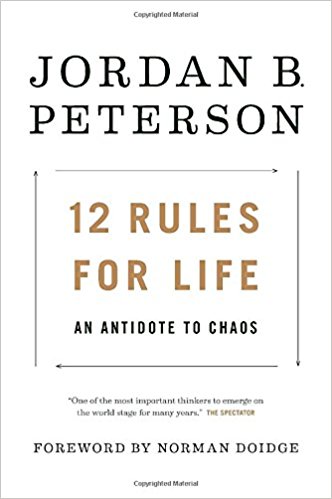
Review of "An Antidote for Chaos"

Image result for antidote for chaos chapter titles
https://www.amazon.com/12-Rules-Life-Antidote-Chaos/dp/0345816021/ref=sr_1_1?ie=UTF8&qid=1532802559&sr=8-1&keywords=antidote+for+chaos&dpID=412z30W2N-L&preST=_SY344_BO1,204,203,200_QL70_&dpSrc=srch

So in the past few weeks, driving between work and home, I've been listening to Dr. Jordan Peterson's "Antidote for Chaos: 12 rules for life."

Despite the self-help-y title of the name, it actually is a fairly interesting read, especially from a Christian perspective.

It is better read as the attempt by a doctor to quantify and summate his observations over many years of clinical practice rather than something he postulates for the purposes of publishing.

As detailed in the foreward, each rule was initially posted online until a publisher asked him to take each "rule" and expand upon it. He discovered that he had a lot more to say on each one, and developed an essay for them, going into the history of that observance, relative academic work, his own clinical experiences, etc.

There is a fair amount of religious imagery in the book, most (but not all) coming from the Bible. In those instances, he pulls a number of things together that I thought were interesting:
  • He weaves a narrative that, even if the Bible isn't true, it has been the core document responsible for western civilization, which, in turn, has, in a relatively short amount of time, advanced mankind from mostly abject poverty, to levels of freedom that are unprecedented, and luxury that even kings a hundred years ago couldn't conceive of. As the core document, the instruction contained within the Bible must be of vital importance for societal cohesion, and the truth for living has to be examined to determine why.
  • Living a life without the idea of God justifies horrors inflicted on one another in a grand scale. He uses the Columbine shooting as a case study several times. Evidently, one of the shooters tried to write out why he felt the way he did before committing the heinous act. Pastors have been using those writings for years to warn against spiritual collapse. However, when the book views it through a psychological eye, then pairs up with a psychological view of the Bible, the results are sometimes bone-chilling. 
  • The psychology of the people of the Bible. We think of them mostly as 2D characters, there for a simple spiritual lesson in light of Jesus, then disposed of. The exploration as to the psychology of their experiences in terms of the Bible, the correction/path change in the Bible, then the circumstances under which we conduct ourselves today was illuminating. Of interest was the close examination of Cain and Abel. One of the things that was particularly illuminating was the need for self-reflection upon failure due to insufficiency. Cain's inability to do so led him to blame outside factors, and take "revenge" upon God by killing Abel. The psychology behind such actions is still with us today, and the book brings it out in vivid detail.
  • The need for Biblical sacrifice, wisdom and living, even in absence of the Bible as a divine document. This was a hard thing for me to deal with. It almost seems like Dr. Peterson (who, by his own account, hasn't made up his mind on the existence of God, but "acts like God exists"), is offering a substitute of Biblical wisdom for those that reject the Bible as the inerrant Word of God. One part of me thinks that this allows people to reap the benefits of living a principled, Godly life without being saved. However, the other wonders if this might be a gateway to get people in a Biblical frame of mind. I haven't resolved this yet.
  • Each chapter has a somewhat curious title that he explains, but he goes into Jack-Hayford level of background to get around to explaining the meaning (those from CoTW know what that means). The stories are at times interesting, tragic, playful, funny, and insightful. Usually a mix. 
Many have tried to pin certain political or spiritual motives to Dr. Peterson in light of this book, usually without reading it.

However, after listening to it, particularly with his emphases being read by the author himself, you realize that his only drive is to get to the truth of a situation.  He's extremely clinical about almost everything he approaches.

I would recommend this book, not as a "it is truth, and you must adhere to what it says", but from a "it will at times reinforce or challenge what you think" standpoint.

Saturday, April 07, 2018

The most inconsiderate Husband ever...

The most thoughtless birthing partner father ever.

(Please note:  I plan on being ultra supportive when Tabitha has our baby.  Inspiration just struck me here, so I thought it'd be funny to go with it.)

At around 3AM, Tab said she had her first real contraction.  She had been having Braxton-Hicks contractions for weeks now, but I had dutifully reminded her each time that it wasn't REAL labor unless they were closer together.

When she told me that they were around 10 minutes apart, I reminded her of what we learned in our birthing class, and that we needed to go in when they were 4 minutes apart.  Guesstimating in my head, I told her to wake me up when they were six minutes apart.

She became so antsy every time a contraction hit that I finally got up in a huff and slept out on the couch, despite it likely ruining the pace of my entire day.

I was awoken 3 hours later by Tabitha nudging me awake that they had finally reached six minutes apart.  I got up and trudged to the bathroom, indignant that she had broken up my sleep.  I took a long, hot shower and finally packed my bag for the hospital trip.

I got in the car, then proceeded to wait 10 minutes for her to gather her prepacked bag and get in.  Once she did get in, I asked if she had locked the door.  As she couldn't remember, I told her to hurry up and check, as she was keeping us from getting to the hospital.

While waiting in the lobby for Tab to park the car, I caught up with the news of the day, checked in to the hospital (I'm the mayor now on Swarm!), and made sure everyone on social media knew we were about to give birth.  As soon as Tabitha got back from the parking structure, she wanted to check in, but I had her wait while I set up the perfect selfie to commemorate the occasion. 

Checking in was fairly uneventful.  We went into the birthing triage room, and spent the next hour there.  The nurses were very attentive towards Tabitha, but refused to go into any depth as to the coffee offerings of the cafeteria below. 

After being demoralized about having to likely put up with substandard coffee, we finally got admitted to the delivery room around hour 7.  I decided that I needed a break, so I got into the relaxation tub.  Boy were they right!  This thing had jets, and even soothing lights to help calm you.  The only thing that ruined it was the screaming woman outside the bathroom.  I yelled for them to quiet it down.  After all, this was ME time.

The doctor came around and told us that if we wanted an epidural, this was the time to do it.  Tabitha said the pain was severe, and that she really thought she needed it. 

Fortunately, I was on hand to remind her, as well as tell the doctor, that we didn't want it, as we were trying to keep costs down on this birth.  "Remember what we said a month ago dear:  No sense going into debt because of this child."

After 13 hours, I told Tab to wrap it up, as the novelty was wearing off, and that, frankly, she was starting to look like an attention hog.

I'm guessing it worked because, after only an hour more, she finally began pushing.  They asked me to cut the cord, but I said no.  It looked unsanitary.

They asked Tabitha if she wanted the baby immediately.  She said yes, but, again, in order to keep things sanitary, I insisted they wash the baby off first.  It look goopy.

Before checking out of the hospital, they insisted that we have a baby seat in the car.  I unsuccessfully tried to argue that my parents didn't have a baby seat when I was brought home, I begrudgingly installed it.  Driving home, Tabitha insisted on sitting in the backseat, despite that this was the first time I actually wanted to talk with her, as she wasn't complaining about pain anymore.

Arriving home, I turned on the TV and returned to my Netflix queue.  I was drastically behind, and needed to really power through to get back on track.

Fatherhood is going to be great!

Thursday, November 30, 2017

So, this is a season of transition. A year and a half ago, I moved sites in my company, Tabitha is pregnant, she moved to a new job outside the company, we moved into a house, and my parents have moved next door.

To add to this all, it has become painfully obvious that my Mustang was not going to cut it in this new phase of my life. So, after 16 years, I decided to finally trade it in for something with a viable back seat. (I can just see the dirty jokes forming in your head)

Unloading all the stuff out of the car, I was hit with a flood of memories:

It was 2001. I was in the final quarters of my Undergrad, and decided to treat myself after a grueling six and a half years in College. I had destroyed my Saturn in a car accident a few months previous.

(Fun fact about the Saturn: My previous car, a Red Ford Probe, had a spacious backseat. The Saturn SC2 did...not... As I was the perpetual DD in college, every time Sev would emerge from the backseat, he'd say, "It's a boy!")

Wanting something with a little more pep, I bought a 1999 "Cinnamon" V6 Mustang with 30,000 miles on it.

One of my very close friends ridiculed me for getting it because, "that's the kind of car you get a girl on her sweet 16." My other friends teased me about getting a FORD ("Fix Or Repair Daily", "Found On Road Dead").

Over the course of the next year, I drove back and forth to Cal Poly Pomona from Woodland Hills 2-3 times a week to finish up my few remaining classes.

I graduated, and hung my tassle there until 2006-ish, when a drunken careless date yanked it down because, "you needed to get rid of that anyway." Upset, and, kinda angry, I threw it in the back, where it was tossed around until I found it last night.

In December of 2002, I got my Job at the Naval Surface Warfare Center Port Hueneme Division. For 3 and a half years, I drove from Woodland Hills to Port Hueneme (one hour each way), putting 100 miles on it every day.

On top of that, most of my friends were at Glendora Alliance Church, so I'd drive an additional hundred miles every weekend to see Matt, Angi, Cameron, Brian, and crew.

I remember a bleary Saturday, waking up in Shannon's house after my going-away party from NAVSEA with the worst hangover I've ever had. (Erik, Sev, and Derek know the one) The Mustang was a manual Transmission, so it was quite a feeling to be pissed at the clutch for being too loud. I packed that car up with all my day-to-day possessions (It wasn't much), then drove out to Goleta to work at my present job.

The next couple years were a blur. I would visit mom and dad in Woodland Hills, my brother John in Costa Mesa, I drove to Vegas twice to support Dennis at the Scottish Festivals, etc.

It was the car in which I made my initial trip up to Stanford to visit my good friend Eric, and started the annual trip to The Great Dickens Christmas Fairthat continues to this day (Next weekend, in fact!)

Then, in a hospital room in 2008, I met a girl. We dated, and she moved up here. For a long time, my Mustang was "the good car" that we'd take when we were trying to look spiffed up.

(Side note: I had promised Tabitha that I would teach her how to drive a manual when I was going to turn the Mustang in. I forgot to do that, and now both our cars are automatics. Oops.)

Despite the years, after 249,000 miles, the Driver's seat was somewhat thrashed, the center console no longer "clicked" close, and the steering wheel was starting to disintegrate. The evaluation at the dealership listed the color as "Was Red"


It was a good little car that gave me very few problems, and I'm sad to see it go. But life is continually about new beginnings, and I'm excited to see where this one takes me.

In a related note, if anyone wants a 1999 Mustang, with a quarter million miles on it, and a severely oxidized paintjob, please contact Toyota of Santa Barbara.


Thursday, December 15, 2016

Unsilencing of a point of view...

Recently, I've been observing that a number of people on the other side of the ideological aisle have run amok online describing how "unsafe" and "scared" they feel.  They think that the country has taken a step back, and things are no longer as good as they once were.

First, I'm old.  I've seen more than a few elections.  I understand the feeling on election night of being on edge during the count, culminating in either a sigh of relief when your candidate wins, or the uncertainty of having a president elect that doesn't champion your values.

However, I remember when I was in college in 2000, and people didn't feel this way.  They grumbled that W won the election, but nobody ran around feeling like their country was in danger in any way.  I was on a fairly liberal campus, and, besides the usual "effing Republicans", there wasn't a huge outcry, especially considering the election was literally decided by fewer votes than the people in my dorm.

So, while it would be easy to say, "Well, Trump/Pence are just THAT evil", if one steps back and looks at the changes to the country at large, we might be able to piece together some other major contributing factors.

First and foremost, there is a push to make people as thin skinned as possible.  The rise of the theory of "intersectionality", third wave feminism, "triggering", "safe spaces", offense at not using arbitrary pronouns, etc. has resulted in people that are incredibly unable to take a critical view of their own beliefs, lest their self-induced identities be jostled.

That entire line of thought ensures that people with opposing viewpoints co-exist without having to challenge one another.  So, the idea that anything would not go their way, or that people might inherently disagree with their point of view, is incredibly difficult to handle.  After all, in their relativistic world, they are right 100% of the time.

And it doesn't end with their viewpoint.  They attempt to enforce it on everyone else I.E. if you don't agree with them, you are painted as racist/sexist/homophobic/hate speech/etc.  You can have your own identity within their walled garden, but don't you dare attempt to climb out of your intellectual gilded cage.

Now here's the thing:  for 30 years, This kind of talk has effectively killed any form of discussion.  The conservative viewpoint has started with an inherent disadvantage.  Before a debate can even begin, they have to justify how they are not deserving of the label of racist/sexist/etc.  This means that the conservatives have been on defense in the public discussion arena for a very long time.

The fact that this tactic has been so effective at silencing conservatives demonstrates the level to which people are not racist:  the idea of even being thought of as racist is enough to dissuade people from engaging in political discourse.  As such, it has been professionally and personally dangerous to hold anything but the liberal point of view for some time now, due to the wide paintbrush of racism/sexism/etc. for anyone that dares step off of the ideological reservation.

What we are seeing in this latest election is the rise of a different breed of conservatism.  These aren't people that are willing to let accusations dissuade them from engaging in political discussions.  They know they aren't racist, sexist, etc.  So, when the left trots out its usual paintbrush, the response is, "No, that's not me.  Please try again."  They aren't racist, and aren't going to roll over and play dead from the usual bag of tricks.

Even attempts to double down using hyper sensitive labels and concepts like "toxic masculinity", "institutional racism", "white privilege", etc. are met with incredulity, scorn, derision, and the loss of an election.

Additionally, conservatives have typically been reserved when it comes to making their political points, relying on typically dull presentations, following laws/rules/analyzing the math/etc.  The other side has not felt the need to maintain themselves along those lines, and enjoyed the ability to be disruptive/rude/shocking/etc. and make their points typically via emotional appeal, which is seductive, in that it provides good feelings over facts.

What is surprising is that fact-based political commentary is providing the best counter this time around.  Granted, it is in a new package that makes it much more easier to present and digest.

People like Ben Shapiro are leading the charge, providing targeted, concise facts to support the conservative point of view, without being mild or gentile about it.  His key phrase is, "facts don't care about your feelings", a phrase which strikes at the very heart of the left's appeal.

As a counter for the more outrageous, they are met by Steven Crowder, who delights in being a provocateur.  He punctuates his talking points using edgy language calculated to troll the other side of the ideological aisle, as has been done in reverse for 30 years.

So they are being met on the high road intellectually, and the low road with the name-calling.  They don't enjoy the smug superiority they once had anymore.

I can understand why the left is now scared:  now they have to defend their viewpoints, and can't shut down their opponents with emotional manipulation.  Their opinions can now be scrutinized for content as opposed to relying on people's sympathies.  Additionally, they are no longer the sole owners of edgy political discourse;  It is now possible to be edgy as well as conservative.

And on that, I can sympathize with the left:  it is an enormous feeling of loss and worry to have been dominating a field for a long time, only to have a serious challenger appear.  I felt the same way when x86 systems had effectively killed Macs, only for the first generation iMacs to appear all over campus.

I look forward to the next few years.  The spell has been broken, and conservatives are now free to come out of hiding and express their viewpoints without reprisal.  There is an open marketplace of ideas that is now ripe with true variety.  Only the close minded would mourn such a rich diversity of thought.

Saturday, November 19, 2016

If I ran things (as if anyone would ask me to)...

So, I wrote this in 2012 to get it all down.  I've recently revisited it, and made a few modifications here and there to account for recent changes in philosophy, but it is interesting how most of it still holds for today.

In writing my thoughts on all things political, I've realized that I need to be very careful in what I say, not only for my career, but because I don't like to alienate anybody.

I enjoy intelligent discourse, as it has shaped my personal point of view. So, when writing this, I subscribe myself to a phrase I have learned to love:  "Be mellow or be gone."

These are MY points of view. I present them as how I think of life here in these United States. If you have a differing opinion, I welcome it in a friendly interaction. 

In the past, I've been more hot-tempered.  My earlier discussions sprinkled over the internet are someone I'm eager to distance myself from (seriously, if you bring them up, I'll send you a polite, "yep, that was me" email back). I've had a chance to evaluate life, and I am glad to entertain people in a more give-and-take format, as long as they are not violating my new favorite phrase.

To me, the construct of a political party is like cable television packages -- You may want to just get HBO and Scifi (it will NEVER be SyFy in my mind), but you are going to get all the oddball channels you will never watch anyway.

I find myself leaning towards what some would consider a Republican slant, but I find that so many who also identify themselves as Republicans cause me extreme facepalms. I got interested when the Tea Party started up, as I thought it would be a return to Conservative ideals, but then the media chose to focus on the racist nutballs that showed up to their demonstrations.  This had the effect of blunting the movement by being characterized as racist, uninformed rednecks, forcing them to silence themselves.

While I liked their ideals, I think the attempt to create a third group out of nothing was a mis-step, as well as their almost non-response to the racist goobers that kept showing up to their events. To that end, I've thought about the creation of a movement inside the Conservative ranks that would distance themselves from the social nature of Conservatism that usually mire the rest of otherwise like-minded people.

Because when you boil all the different social pushes away, you get to the core of what Conservatism is: giving people the opportunity to succeed as individuals in the United States.

Please don't misunderstand me: I am a Christian, and I'll proudly say that, but I don't think that Christians are doing the right thing by pushing to legislate socially moral code.  You can only legislate morality insomuch as action, never intent.

In any case, for those of you Christians out there who are going to read this and wonder how I can reconcile my Christianity with what I am about to propose, I've created a section at the end of this post that will explain everything, in my mind, anyway. For those of you not of a Christian persuasion, that section will have a lot of Christian terms that might require a bit of translation. Chances are, if you get offended, you are misunderstanding what is being said.  I'll be happy to clarify if it is needed.

I've struggled with what to call this idea, and the best I can come up with is, "Conservatives Without A Social Agenda". I think that the proper place for government is out of the social agenda of either side.  There are ideas here that are going to make Conservatives hoop and holler with glee, but then turn around and piss them right off. Stick with it to the end, and you'll see my justification for everything.

See, I've long looked at people who call themselves Conservatives, and thought, "wow, what a bunch of pious gas-bags." They radically mis-interpret The Bible to their political ends, or legislate morality that they clearly don't follow or understand. They know that they can pander to their constituents with a token morality play without making meaningful changes to their own lives.  I think this movement will remove one of their tools of manipulation of the Christian voter.

Likewise, a candidate that might have sound ideas can be mired in talk of "is he conservative enough" if his perceived social agenda doesn't line up with hardline conservative social thoughts.

It's a distraction that doesn't help anyone in the long run, and only serves to further divide otherwise sound schools of thought.

My first thought that I wish to address actually comes from the Liberal point of view: "You can't legislate morality." I agree with this 100%. I don't think you can make people be nice to each other, join a religion, be upstanding people, etc. through laws.

However, there is a flip side; a corollary, if you will: "you can't legislate concern for your fellow man."

So much of what people concern themselves with in the public forum is an attempt to shape the social atmosphere of the country. My point of view is that the government should not concern itself with the social whims of the populace, but should instead provide a framework that people can use. 

Government needs to stop trying to edge closer to providing their citizens with "safe spaces", and return to being a jungle-gym that people can launch their lives from. To pull the analogy out further, it's time to take the rubber safety bumpers off.

I suppose before I go further, I should explain my background: I am an engineer. The rampant viewpoint where I work is one of, "I don't care what your background is, who you are, or where you come from. Can you get the job done within X days and with Y budget? Yes? Get it done then." 

Engineers are free to dream up new ideas, solve problems, and, (with a minimum of politics) rise through the ranks as their solutions are deemed good or not by bosses and outside customers. The best description I can come up for this environment is a "meritocracy." People are advanced or held back based on their usefulness.

This is how I think government should interact with people. We need to remember that The Constitution only guarantees us the "pursuit of happiness", not happiness itself.

So, this posting is my attempt to go through issues, if I was Conservative, but had no social agenda.

We'll start with something nice and easy, like Gay Marriage: As far as the government is concerned, people of the same sex shouldn't be considered "Married."

If you stopped reading at this point and decided to post a nasty response, or closed my blog, it means you are not open to discussion. (Of course, if you did that, you're not reading this either. So let me say some nonsense in here: bliggidity nando bloopski!)

Let me continue: people of the opposite sex shouldn't be considered "Married" either.

Frankly, the government shouldn't be capable of defining what is or is not a marriage. That should be a matter for the religious entities to determine for themselves. As far as government is concerned, people (gay and straight), both should be in the state of "civil union" with their "partner."  The word "Marriage" ascribes too much religious and societal connotations. As long as insurance, benefit coverage, etc. are equal amongst the various forms of civil unions, there shouldn't be a problem.

This is not "separate but equal."  This is just "equal."

I know it feels like a parent saying, "if you aren't going to play nice, then neither of you gets it", but we as a society need to move on. These two groups are never going to effectively communicate, never relent, and only shout louder.

Next up on my list in terms of easy-to-tackle points: gun control. On this topic, I agree pretty much with the conservative view, but think it has been drastically misrepresented, with conservatives hesitant to speak up.

So let me get up on this little soapbox and squeak: The purpose of the second amendment is not to protect one's house, nor to hunt; it was to prevent a coup from those in power to declare democracy a failure, and revert to a non representative form of government.

Ironically, one of the most common name-calling jibes the Liberal side tends to heap on the Conservative side is "fascist."

 Allow me a diversion for a moment. I promise to return to the previous point:
"but if circumstances should at any time oblige the government to form an army of any magnitude that army can never be formidable to the liberties of the people while there is a large body of citizens, little, if at all, inferior to them in discipline and the use of arms, who stand ready to defend their own rights and those of their fellow-citizens. This appears to me the only substitute that can be devised for a standing army, and the best possible security against it, if it should exist." --Federalist Paper #29.
For the "tl;dr" crowd, that means that, if anything, the Second Amendment proliferation of firearms should be on the same level as our armed forces such that if a fascist government did pop up, the people could overthrow them with comparable armaments.

So the people calling conservatives "fascist" should be advocating the proliferation of firearms, such that if fascism should come to power, it can be overcome.

The biggest issue that I can see is that, while I can agree that the handling of such requires a level of respect, the idea of severely disarming our country, or only leaving them with token firearms runs contrary to what the Second Amendment was built for.

Another point is that the only people that follow firearm laws are law-abiding people. Criminals, by definition, do not follow the law.

92% of the more horrific gun-sprees in the last decade have taken place in places that have taken pride on being "gun-free zones."  All gun-free zones means is that you have concentrated a population of targets. As my friend Jason says: "when seconds count, the cops are minutes away."

The failure of gun laws isn't in the laws themselves, but rather the implementation. The DROS delay should be a quick online check that takes seconds.

From there, you should be able to purchase as many firearms as possible as often as you like. If you get convicted of a felony, it should trigger that you have guns, and they need to be confiscated. If you try to purchase another gun, a quick online check should deny the sale.

The California restriction of one gun a month, and a 10 day delay each time is silly. It is a question of a viable IT infrastructure, not draconian laws.

Next on our topic of light friendly discussion, we have abortion. I think they should be legal, and I think the government has no business funding it in any way.

The argument for abortion is that it isn't a person, it is classified as just a bunch of tissue, so it shouldn't be given special funding or status. If that is the case, government should not be involved in funding what is an inconvenience procedure 90%+ of the time.

And laws that declare the death of a mother and her child/fetus should return to being a single murder charge. Either it is a person or it is not. Our laws should be uniform.

College and Arts funding -- The US has fallen drastically behind in Science, engineering, math, etc. graduates. I think there is one way to fix that problem: stop giving student loans or grants to anything but Science, Technology, Engineering, and Mathematics.

Go onto any campus, and you'll see people floundering in college, often settling on a humanities/liberal arts degree as a means to "get a college degree". Meanwhile, they rack up huge student loans.

I think being a liberal arts or humanities degree should be a burning desire. It should come from the same well of desire that pushed many of our cultural greats to develop their talent further.

It should not come from, "I flunked out of differential Equations, so I had to change majors, and English seemed like a good fit because I can read."  As an engineering major, I saw this story play out many, many, many times.

This also explains why I feel the way I do about government funded art: it shouldn't exist.

Art should bring about funding due to the patron desiring to fund it, or a burning need to create, not out of a section of taxpayer supplied budget.

Now for General Education. Having been a product of the Los Angeles Unified School District, I can tell you what needs to happen: The responsibility of the school should be to its students and local residents, not to a remote Superintendent a hundred miles away who has little day to day involvement with the students and staff.

Next is unions: a minor thought, but I think that unions are a concept whose time is done. In the day and age of class-action lawsuits, the original purpose of the union is gone.

Now they serve little purpose, very often destroying the workers' companies, and arguably, entire industries, while claiming to help the workers.  (Ever wonder why US-made Steel was virtually non-existent until just a few years ago?)

Embryonic Stem Cell research. This is one where I think both sides need to chill the eff down.

Researchers have gotten down to base cells from skin cells, perhaps negating the need to use embryonic cells. If not, the use of the remains of IVF treatments after a successful fertilization would make for good resources. They are going to be thrown away anyway. Might as well put them to good use.

Overall, the government needs to get out of the business of competing and instead remember that its only job is to regulate. Like the jungle gym analogy earlier, it needs to provide just the base frame for others to launch from.
  • It should ensure no monopolies, oligarchies, or collusion exist in a given industry. 
  • It should ensure valid competition exists, all proper regulations are being followed, then move on. 
  • It should never be viewed as a profitable enterprise. 
  • No company should ever be considered "too big to fail." 
  • Corporate personhood should include the right to have said person arrested. 
  • Banks and financial institutions should be more highly regulated.  However, that regulation should be just that, regulation. At no point should it enter into the fray and provide a government alternative. 
The next one is a touchy one (like what else isn't on this list?). I'm talking about environmentalism. I think people can agree that the earth is changing. And I'm sure that is a scary thing.

The ground is supposed to be "solid". There seems to be this need to change things "back" to the way they were, forgetting that nature itself is a moving, dynamic, changing thing. We've only been seriously taking samples for the last ~200 years, which is a small thing. We are extrapolating data from indirect means past that.

We have lots of scientists chasing lots of dollars to come up with ways that humans are causing it, as that is where the grant money is.

I'm not saying industries shouldn't try to get off of oil. I'm saying that people who claim that, "we need to come up with ways to reduce emissions! Why is that so bad?" 3 things on that subject:

  1. If humans aren't the cause, or are, at most, a minor contributor to an otherwise natural phenomenon, we are spending many hundreds of billions of dollars on nothing. 
  2. We are imposing restrictions on third world countries trying to get their manufacturing infrastructure up and running. They are trying to lift themselves out of poverty, but we in the first world are imposing our worries and concerns on them. 
  3. The need to "do something" has lead to unintended consequences that we may not know about until it is too late. 
As an example for that last point, Lead/nickel/lithium in hybrid car batteries are a major environmental problem waiting to happen as the hybrid/electrical cars crash and age out. The only reason it isn't a major issue yet is because of the low numbers.

The ethics of those in the scientific community are also in question. Research funded by corporations have their own slant towards the corporation, research funded by government sources contain the promise of more funding if issues are discovered. So, why is it so hard to believe that scientists aren't "finding" more problems in an attempt to get more funding?  We've seen more than a few examples of people fudging results in the last few years.  They are not above corruption.

The solution is that there needs to be more double-blind studies. Funding sources should be kept from research. The science needs to be pure.

Now the defense budget. Defense is in the national interest. (as a sign I saw once said: "Governments don't have friends. They have interests.")

It isn't a matter of compassion or whimsy: A country without an army will not be a country much longer. Funding for defense directly equals jobs. To reduce one almost exactly reduces the other.

Having experience in this, I can tell you that the funding for this in 99% of all cases is tracked to a meticulous degree.

Compared to "soft" sources of funding for other governmental purchases, military spending is tracked down to the dollar, with multiple levels of overlap, and mandatory ethics training for both contractor and government employees alike. The few cases you see where money is mis-spent are usually discovered quickly, and the cost to the individual is severe.

Despite what you have been lead to believe in the movies, the military doesn't take kindly to corruption.

Another benefit to defense spending is technological trickle down. The high demand in government circles for extremely high-speed, high reliability parts usually gets transferred to civilian use afterwards, where it benefits society at large.

The key is to get the government away from COTS (Commercial Off-The-Shelf) use. The government needs to start coming up with new and riskier technologies to champion. Sure it might not pay off 100% of the time, but when it does, you end up with the Internet and GPS.

On the subject of health care: We have been sold a bill of goods. We have been told that we need health insurance in order to get health care.

That is not true.

The reason we need health insurance is because the cost of health care is so high.

Why is it high?  A variety of reasons, most of which are fixable with proper policies, ranging from monopoly/advertising restrictions of pharmaceutical companies, to tort reform to bring down medical malpractice insurance claims and premiums.

Medical insurance should be an option, with the possibility of absorbing costs without the need for insurance for a moderately healthy person.

We need to do something.  Small businesses need to succeed.  Right now, they are hampered by laws, regulations, and nonsensical fees for no appreciable gain.

My father is a General Contractor going on 30 years now, working for himself, never having had a crew bigger than 6 or 7 people. Every year, the Federal and State governments leverage more rules, taxes, etc. on him to the point that he has had to eliminate his crew and work by himself now.  The increase in payroll, insurance, etc. have made it unprofitable for him to keep any crew together.

Now, he only pulls in people when he needs to, has drastically reduced the number of jobs he can tackle, and is resigned to never being able to retire.  This isn't due to him not being competent or unable to find work.  This is because he is unable to keep a crew going without incurring significant costs.  The barrier to employ even one person is huge, and would make most of his projects unprofitable, and contribute to him having to spend all of his time dealing with regulation rather than actually working on construction projects.

So where are we after this large diatribe? You might be asking, "where is the compassion in all of this?"

There isn't any.  Conservatism is the freeing of individuals to pursue happiness.  If people are wanting to be compassionate, they should use their now-free money and time to contribute to community efforts.  I think it would be an excellent use for it, but it shouldn't be mandated.

And don't get me wrong, I believe in community efforts.  I run Linux, which is a largely community driven operating system, made from people donating their free time.  It can work.

I know there are corner cases and exceptions to every rule.  However, in broad strokes, this is how I think the country should be operated.  Individual freedom allows for group freedom.

And now, for the section I promised to my fellow Christians:

This part might hurt:  The US never was a Christian nation.  The people leading it might have been mostly Christian, but in no way did they codify that in the founding documents.  The best you can argue for is that they were "theists."  You'll notice lots of references to "God", "creator", etc.  But in no way did the US ever put itself under the aegis of Christ.  So there is no "returning Christ to America."

A couple notes on this:

  1. In 1 Corinthians 5:12-13, Paul specifically states that we are not to judge those outside the church. They are not living in Christ, and we are not to impose Christ's teachings on them.  That is God's concern.  You are not God.  Our concern is only to the great commission.  It's time to refocus.
  2. The second note is the example of Daniel.  He was put in charge in a land that was hostile to his beliefs.  Rather than being told to impose his Jewish beliefs in the land he was in, especially in his position of power.  He lived his life in Babylon, and rather, chose to focus inwardly on his relationship with God.  I earnestly believe that the role of Christians in the US is to live immersed in society, but finding your identity in Christ.  

The natural progression for this line of thought is that I believe the church should remove itself from all politics.  The corporate church should not interface with government, except to get the requisite permits, etc. as needed to interface with local laws.

Past that point, it is the job of the church to train up the people to do the work of Christ.  I think it is unwise when a pastor unilaterally decides that they will corporately involve the church in some secular function, even with the best of intentions.  I think the purpose and focus of the church should be to develop and disciple people, and let their conscious, as shaped by their teachings inside the church, lead them to be a light in their community as they see fit.

As stated before, I welcome goodnatured, civil debate and discussion.  Rule of thumb is:  Be Mellow or be gone.